Introduction
Mexico is a diverse country filled with historic cities, Caribbean beaches, mountain landscapes, archaeological sites, colonial towns, and scenic coastal roads. Although buses, taxis, domestic flights, and local public transportation are widely available, they may not always provide the flexibility travelers need. A self-drive rental in Mexico allows visitors to create their own schedule, stop at lesser-known attractions, carry their luggage conveniently, and explore destinations beyond major tourist centers.
Travelers can rent cars, scooters, commuter motorcycles, adventure bikes, electric vehicles, and other transportation options depending on the destination and purpose of the trip. A compact car may be suitable for a family road trip, while a scooter can make short journeys around Playa del Carmen, Cancún, Tulum, Cozumel, or Puerto Vallarta more convenient.
For Indian travelers accustomed to busy roads in Delhi, Mumbai, Bangalore, Hyderabad, Pune, Chennai, or Kolkata, some parts of Mexico may feel familiar. However, local road signs, insurance rules, speed limits, toll systems, rental agreements, driving customs, and safety conditions can be different. Travelers should therefore understand the rental process before collecting a vehicle.
This guide explains how to choose a rental vehicle, which documents may be required, what to inspect, how rental pricing works, and how to travel safely. It is designed for first-time visitors, students, working professionals, backpackers, couples, families, daily commuters, and budget-conscious travelers using MotoShare Mexico.
Why Renting a Vehicle in Mexico Is a Smart Choice
Mexico covers a large geographical area, and many of its best attractions are located outside central urban areas. Public transportation may connect major cities, but it does not always reach beaches, villages, natural parks, archaeological sites, or countryside attractions conveniently.
A self-drive rental can be useful for routes such as:
- Cancún to Playa del Carmen, Tulum, and nearby cenotes
- Mérida to Uxmal and other locations across the Yucatán Peninsula
- Mexico City to Puebla, Cholula, or nearby heritage towns
- Guadalajara to Tequila and Lake Chapala
- Oaxaca City to surrounding villages and natural attractions
- Puerto Vallarta to Sayulita and San Pancho
- La Paz to Todos Santos and coastal areas in Baja California Sur
- San Miguel de Allende to Guanajuato and Querétaro
Renting a vehicle also allows travelers to avoid repeatedly negotiating taxi fares or waiting for transportation. Groups can divide the rental and fuel expenses, while solo travelers can use a scooter or small motorcycle for economical local travel.
However, renting is not automatically the best option everywhere. In central Mexico City, for example, traffic, restricted parking, busy junctions, and public transportation availability may make a rental vehicle unnecessary for short urban trips. The correct choice depends on the destination, itinerary, group size, luggage, driving experience, and budget.
Who Should Consider a Self-Drive Rental in Mexico?
A rental vehicle can benefit several types of travelers.
First-Time International Travelers
A rental car can provide privacy, luggage space, and direct transportation between hotels and attractions. First-time visitors should select simple routes and avoid unfamiliar driving conditions at night.
Families and Small Groups
Families can travel together without booking multiple taxis. A car also provides space for bags, child seats, food, and personal belongings.
Backpackers and Budget Travelers
Backpackers staying in one coastal town may find a scooter more economical than taking several short taxi rides. Weekly rentals may offer a lower daily price than one-day bookings.
Couples
Couples planning beach trips, countryside drives, or heritage routes can enjoy greater privacy and flexibility with a compact car or scooter.
Students and Working Professionals
Students, digital nomads, and professionals staying for several weeks may use a motorcycle, scooter, or small car for commuting between accommodation, educational institutions, coworking spaces, and local attractions.
Experienced Motorcycle Riders
Travelers with appropriate riding experience may prefer a motorcycle for coastal highways, scenic countryside routes, or adventure travel. Large motorcycles should only be selected by riders who are comfortable handling their weight and power.
Benefits of Self-Drive Rentals for First-Time Travelers
Freedom to Create Your Own Schedule
Travelers do not need to organize the entire day around bus departures, shared tours, or taxi availability. They can leave early, stay longer at an attraction, or modify their route.
Access to Less-Crowded Places
Some beaches, cenotes, natural attractions, small towns, and archaeological sites are difficult to reach using public transportation. A rental vehicle makes these destinations more accessible.
Better Value for Groups
A group of three or four people may find a compact car more economical than paying separately for multiple transfers and taxis.
Convenient Luggage Transportation
Cars are useful for airport transfers, hotel changes, shopping, and multi-city trips involving several bags.
Greater Privacy
A self-drive vehicle gives travelers personal space and reduces dependence on unfamiliar drivers or crowded transportation.
More Local Travel Experiences
Driving allows visitors to stop at local markets, family-run restaurants, viewpoints, roadside attractions, and smaller communities that may not be included in standard tourist itineraries.
Types of Vehicles You Can Rent in Mexico
Scooters
Scooters are useful for short urban and coastal journeys. Their automatic transmission and manageable size make them easier to operate than larger motorcycles.
They may be suitable for:
- Playa del Carmen
- Cozumel
- Isla Mujeres
- Tulum
- Puerto Vallarta
- Smaller coastal communities
Scooters are less suitable for high-speed highways, long journeys, heavy luggage, poor weather, or rough roads.
Commuter Motorcycles
Commuter motorcycles generally provide better stability and range than basic scooters. They may suit experienced riders traveling around a city or between nearby towns.
They usually offer:
- Good fuel efficiency
- Easier parking
- Lower rental costs than premium motorcycles
- Better performance on longer roads than small scooters
Sports Bikes
Sports motorcycles offer powerful acceleration and responsive handling. They are generally not recommended for first-time riders, crowded tourist areas, or relaxed sightseeing trips.
Travelers should only choose one when they possess the correct licence, suitable experience, protective equipment, and confidence handling a high-performance motorcycle.
Adventure Bikes
Adventure motorcycles may be appropriate for long-distance routes, varied terrain, and journeys involving mountain or countryside roads. They usually provide comfortable riding positions, larger fuel tanks, and better luggage options.
Their height and weight can make them difficult for inexperienced riders. Before renting, check whether the agreement permits travel on unpaved roads.
Cruiser Motorcycles
Cruisers are designed for relaxed riding and may suit scenic coastal or highway journeys. Their lower seat height can be comfortable, but their weight requires careful handling, especially during parking and low-speed turns.
Electric Bikes and Scooters
Electric two-wheelers can be convenient for short city journeys. Before booking one, confirm:
- Battery range
- Charging time
- Charging locations
- Replacement or roadside support
- Whether the hotel allows charging
- Charges for returning the vehicle with a low battery
Compact Cars
Compact cars are suitable for couples, solo travelers, and small families. They are easier to park, generally consume less fuel, and often cost less than larger vehicles.
Sedans
A sedan offers additional passenger and luggage space. It may be appropriate for airport transfers, business travel, intercity trips, and family holidays.
SUVs
An SUV may be useful for larger groups, additional luggage, longer road trips, or routes with uneven surfaces. However, SUVs generally cost more to rent and operate.
Vans and Multi-Purpose Vehicles
Larger vehicles are suitable for extended families and groups. Travelers should confirm seating capacity, luggage space, parking arrangements, and whether the driver is comfortable handling a larger vehicle.
How to Choose the Right Rental Vehicle for Your Trip
Choosing the correct vehicle is one of the most important parts of safe travel.
Consider Your Destination
A small scooter may work well in a compact coastal town but may not be appropriate for a long highway route. A car may be unnecessary in a walkable neighborhood but valuable for a road trip across the Yucatán Peninsula.
Calculate the Number of Passengers
Do not select a vehicle only according to its advertised seating capacity. Consider how much luggage each passenger will carry. A compact car that technically seats five people may not accommodate five large suitcases.
Assess Your Experience Honestly
Select a vehicle you can operate confidently. A traveler who normally rides a lightweight commuter bike in Pune or Bangalore should not automatically choose a heavy adventure motorcycle in Mexico.
Check the Transmission Type
Many Indian drivers are familiar with manual cars, while travelers from other countries may prefer automatic vehicles. Confirm the transmission before booking because changing vehicles at the rental counter may cost more.
Estimate Your Daily Distance
Scooters are appropriate for short distances. Cars and touring motorcycles are generally better for longer routes, especially when traveling with luggage.
Consider Weather Conditions
Mexico’s climate varies significantly by region and season. Coastal heat, heavy rain, strong winds, mountain temperatures, and tropical weather can affect driving conditions.
Compare the Total Cost
The lowest advertised daily rate is not always the cheapest final option. Include:
- Mandatory insurance
- Optional protection
- Taxes
- security deposit
- Fuel
- tolls
- parking
- additional-driver charges
- young-driver charges
- late-return fees
- delivery and collection charges
- mileage charges
Documents Usually Needed to Rent a Vehicle in Mexico
Rental requirements can differ according to the company, location, vehicle category, and driver’s nationality. Travelers should confirm the exact conditions before arrival.
Valid Driving Licence
The driver normally needs a current driving licence that covers the vehicle category being rented.
An Indian driving licence may be accepted by some providers when it is valid, clearly printed, and written in English. However, provider policies and local interpretations can vary.
International Driving Permit
An International Driving Permit may be requested or recommended when a traveller’s licence is not easily understood by local authorities or rental staff. Indian visitors should carry the permit alongside their original licence rather than treating it as a replacement.
Confirm the requirement directly with the rental provider before booking.
Passport
International travelers will generally need a valid passport as identification. The name on the booking, passport, driving licence, and payment card should match.
Immigration or Entry Documentation
A provider may request proof that the traveler has entered Mexico legally. Keep digital and physical copies of relevant travel documents.
Payment Card
Many car-rental companies require a credit card in the main driver’s name to block a security deposit. Debit cards may not always be accepted or may involve additional restrictions.
Scooter and motorcycle providers may have different deposit policies.
Address and Contact Information
The rental company may ask for:
- Hotel or accommodation address
- Mobile number
- Email address
- Emergency contact information
- Home-country address
Security Deposit
The security deposit depends on the vehicle, rental company, insurance package, payment method, and driver profile. Clarify whether it will be charged or temporarily blocked and how long its release may take after the vehicle is returned.
Things to Check Before Accepting a Rental Vehicle
Never leave the collection location without inspecting the vehicle and understanding the agreement.
Vehicle Condition
Walk around the vehicle and photograph or record:
- Scratches
- Dents
- Cracked lights
- Damaged mirrors
- Wheel and tyre condition
- Windscreen marks
- Seat damage
- Missing accessories
- Fuel or battery level
- Odometer reading
Make sure all visible damage is written on the inspection form or included in the digital condition report.
For motorcycles, also inspect the chain, brakes, tyres, indicators, horn, stands, controls, mirrors, and visible fluid leaks.
Fuel Policy
Common policies include full-to-full, same-to-same, prepaid fuel, or electric charging requirements. A full-to-full policy is usually easier to understand because the renter returns the vehicle with a full tank.
Keep the final fuel receipt in case the provider requests proof.
Insurance Coverage
Confirm exactly what the quoted rate includes. Ask about:
- Third-party liability
- Collision damage
- Theft protection
- Deductible or excess amount
- Personal accident cover
- Windscreen and tyre damage
- Roadside assistance
- Excluded locations or road types
Do not assume that travel insurance or card benefits automatically provide sufficient protection in Mexico.
Mileage Limits
Some rentals include unlimited kilometres, while others charge after a daily limit. Estimate your route before choosing a limited-mileage plan.
Helmet Availability
A motorcycle or scooter booking should include a properly fitting helmet for every rider and passenger. Check the helmet for cracks, damaged straps, loose padding, or a poor fit.
Consider using your own certified helmet for longer or more demanding journeys.
Rental Agreement Terms
Read the agreement before signing it. Pay attention to:
- Permitted drivers
- Geographic limits
- Border restrictions
- Off-road restrictions
- Toll responsibility
- accident-reporting procedure
- breakdown procedure
- traffic fines
- cancellation rules
- late-return charges
- cleaning fees
- lost-key charges
- prohibited uses
- vehicle-return location
Ask for a copy in a language you understand wherever possible.
Emergency Equipment
A car should have suitable safety equipment as required or provided by the operator. Ask about the spare tyre or repair kit, jack, warning triangle, reflective equipment, and emergency contact number.
Safety Tips for Driving a Rental Vehicle in Mexico
Learn the Basic Road Signs
Mexican signs are generally written in Spanish. Learn common terms such as:
- Alto: Stop
- Despacio: Slow
- Curva peligrosa: Dangerous curve
- No estacionarse: No parking
- Desviación: Diversion
- Caseta: Toll booth
- Salida: Exit
- Zona escolar: School zone
Downloading offline maps can help when mobile coverage is weak.
Follow Posted Speed Limits
Speed limits vary according to the road and area. Never rely only on the behavior of surrounding drivers. Watch for signs when entering villages, school zones, highways, and construction areas.
Wear a Helmet
The rider and passenger should wear properly secured helmets on every journey, even when traveling a short distance. Motorcycle rules may vary by state or municipality, so check local regulations.
Use Seat Belts
Every car passenger should use a seat belt. Children should use appropriate child restraints based on applicable local rules and their age or size.
Avoid Overspeeding
Overspeeding reduces reaction time and makes unfamiliar road conditions more dangerous. Slow down around junctions, towns, animals, pedestrians, rain, and roadworks.
Avoid Driving at Night on Unfamiliar Routes
Poor lighting, animals, road damage, reduced visibility, fatigue, and limited assistance can make night driving more difficult. Plan to arrive before dark, particularly in rural areas.
Watch for Speed Bumps
Mexico has many speed bumps, commonly called topes. Some are clearly marked, while others may be difficult to see. Slow down when entering settlements or approaching pedestrian areas.
Use Toll Roads When Appropriate
Toll roads can offer more controlled routes for long journeys, although they increase the travel cost. Carry an accepted payment method and keep toll receipts.
Before departure, check whether the rental provider uses an electronic toll system and whether administrative charges apply.
Avoid Using Your Phone While Driving
Set navigation before moving and use a secure mount if permitted. Stop in a safe location to change the destination, answer messages, or make calls.
Do Not Drink and Drive
Alcohol affects judgment, reaction time, and coordination. Use a taxi or local transportation when planning to drink.
Monitor Weather and Road Conditions
Heavy rain, tropical storms, flooding, strong winds, mountain fog, and extreme heat can affect routes. Check conditions before a long drive and postpone travel when necessary.
Keep Emergency Information Available
Save the rental provider’s roadside-assistance and accident-reporting numbers. Keep copies of the agreement, insurance details, identification, and emergency contacts.
Do Not Leave Valuables Visible
Keep passports, money, electronics, luggage, and travel documents out of sight. Use secure parking and avoid leaving valuables unattended in a scooter compartment or open vehicle.
Follow the Approved Route
Do not enter unpaved roads, beaches, remote trails, or restricted zones unless the agreement expressly permits it. Insurance may not cover damage caused in prohibited areas.
Indicative Cost of Vehicle Rental in Mexico
Rental prices vary according to city, season, vehicle, booking period, availability, insurance package, age requirements, and collection location. Airport rentals and peak holiday periods may be more expensive.
The following ranges are general planning estimates rather than guaranteed MotoShare Mexico prices.
| Vehicle Category | Indicative Daily Base Range |
|---|---|
| Basic scooter | MXN 400–800 |
| Commuter motorcycle | MXN 600–1,200 |
| Premium or cruiser motorcycle | MXN 1,200–2,500 |
| Adventure motorcycle | MXN 1,500–3,500 or more |
| Economy car | MXN 500–1,200 |
| Sedan | MXN 700–1,600 |
| SUV | MXN 1,000–2,500 or more |
The final amount may increase after insurance, tax, security-deposit requirements, delivery, equipment, or optional services are included.
Weekly rentals may provide lower effective daily rates. Before paying, ask for the complete amount in Mexican pesos and check whether the quote includes all mandatory charges.
Common Mistakes First-Time Travelers Should Avoid
Choosing Only by the Lowest Advertised Price
Very low rates may exclude essential insurance, taxes, equipment, or service charges. Compare the total payable amount.
Skipping the Inspection
Without photographs and a signed damage record, a renter may have difficulty proving that damage existed before collection.
Assuming Insurance Covers Everything
Insurance may include exclusions, deductibles, geographic limits, and specific reporting requirements. Read the policy details.
Renting a Vehicle That Is Too Powerful
A holiday is not the right time to learn how to handle a heavy or high-performance motorcycle.
Ignoring the Deposit Policy
A large deposit can reduce the available limit on a traveler’s card. Confirm the amount before booking.
Driving Long Distances Immediately After a Flight
Jet lag and fatigue can reduce concentration. Indian travelers arriving after a long international journey should rest before beginning a demanding drive.
Relying Completely on Mobile Internet
Download maps, hotel details, booking confirmations, and emergency numbers before departure.
Returning the Vehicle Late
Even a short delay may result in an additional charge. Allow time for refueling, traffic, parking, and inspection.
Taking the Vehicle Outside the Permitted Area
Interstate journeys, ferry travel, border crossings, and off-road routes may require prior approval.
Forgetting to Check Parking Rules
Illegal parking may result in fines, towing, or wheel immobilization. Ask the accommodation provider about secure parking.
Self-Drive Rental vs Public Transport vs Taxi
| Factor | Self-Drive Rental | Public Transport | Taxi or Ride Service |
|---|---|---|---|
| Cost | Economical for groups or frequent journeys but includes fuel, insurance, tolls, and parking | Usually the lowest-cost option | Affordable for occasional short trips but expensive for repeated or long journeys |
| Convenience | Direct travel with luggage and control over departure times | May require transfers, waiting, and fixed schedules | Door-to-door travel without driving responsibilities |
| Flexibility | Excellent for changing routes and visiting remote locations | Limited by routes and timetables | Good within service areas but depends on availability |
| Comfort | Private space and control over stops | Can be crowded and less comfortable with luggage | Comfortable for short journeys |
| Travel Experience | Supports independent road trips and spontaneous stops | Offers a local experience at a lower cost | Simple and suitable for travelers unfamiliar with local roads |
| Best Use Cases | Road trips, families, groups, multi-stop itineraries, remote attractions | City travel, budget trips, established intercity routes | Airport transfers, evenings, short urban journeys, travelers who prefer not to drive |
A combined approach often works best. Travelers can use public transportation in central Mexico City, rent a car for a regional road trip, and use taxis for evening journeys.
Special Advice for Indian Travelers Driving in Mexico
Travelers from India may already be comfortable with busy junctions, motorcycles, pedestrians, unpredictable traffic, and mixed road users. However, familiarity with Indian roads should not create overconfidence.
Remember these differences:
- Mexico drives on the right side of the road, while India drives on the left.
- The steering wheel in most Mexican rental cars is on the left.
- Roundabouts, left turns, overtaking, and lane positioning require additional concentration.
- Road signs are primarily in Spanish.
- Toll-road procedures may be unfamiliar.
- Insurance and accident-reporting requirements may differ significantly.
- Rental providers may place a substantial card hold as a security deposit.
Spend a few minutes becoming familiar with the controls before leaving. First-time right-side drivers should begin in a quiet area rather than entering a busy highway immediately.
Experiences from Delhi, Mumbai, Bangalore, Goa, Jaipur, Pune, Hyderabad, Chennai, or Kolkata may help with traffic awareness, but Mexico has its own regulations and local driving culture.
What to Do If the Vehicle Breaks Down
Move the vehicle to a safe location when possible and turn on the hazard lights. Do not attempt a major repair without authorization from the provider.
Contact the rental company and provide:
- Your name
- Booking reference
- Vehicle location
- Vehicle registration details
- Description of the issue
- Photographs or video
- Whether the vehicle is blocking traffic
- Whether anyone is injured
Follow the provider’s instructions about roadside assistance, towing, repairs, and replacement vehicles. Keep receipts and records of every conversation.
What to Do After an Accident
Safety should be the first priority.
- Stop in a safe location when possible.
- Check whether anyone is injured.
- Contact emergency services when necessary.
- Call the rental provider and insurer immediately.
- Do not leave the scene improperly.
- Avoid admitting responsibility or making informal payments.
- Photograph the vehicles, road, damage, signs, and surrounding area.
- Record the other driver’s information and vehicle details.
- Obtain the required official report.
- Follow the insurer’s and rental company’s instructions.
Failure to follow the reporting process may affect insurance coverage.
How MotoShare Mexico Can Help Travelers
MotoShare Mexico is designed to make vehicle discovery and rental planning easier for travelers seeking convenient transportation through motoshare.mx.
Easy Online Booking
Travelers can search for a suitable vehicle, compare available options, review rental conditions, and organize their journey online.
Wide Range of Vehicles
Different trips require different transportation. MotoShare Mexico can help users explore choices such as scooters, motorcycles, compact cars, sedans, SUVs, and other self-drive vehicles based on availability.
Transparent Pricing
Clear pricing helps travelers understand the expected rental cost and compare options more effectively. Users should review the complete booking summary, deposit, insurance, and additional charges before payment.
Verified Vehicle Owners and Providers
Verification processes can help improve trust between renters and vehicle owners or rental partners. Travelers should still inspect the vehicle and retain copies of all booking documents.
Flexible Rental Options
Depending on availability, users may search for hourly, daily, weekly, or longer-term transportation suitable for tourism, commuting, business travel, or road trips.
Options Across Mexican Destinations
MotoShare Mexico aims to help travelers find practical mobility solutions in major cities, tourist centers, and expanding travel markets across Mexico.
Support for Different Travel Budgets
Budget travelers can search for practical scooters or economy vehicles, while families and groups can compare larger cars and SUVs.
Frequently Asked Questions
1- Can tourists rent a vehicle in Mexico?
Yes, tourists can generally rent a car, scooter, or motorcycle in Mexico when they meet the provider’s age, licence, identification, payment, and deposit requirements. Policies differ, so review the conditions before booking.
2- Can Indian tourists use an Indian driving licence in Mexico?
Some providers may accept a valid Indian driving licence, particularly when its information is clearly printed in English. However, rental rules can vary. Carrying an International Driving Permit with the original licence can reduce language-related difficulties.
3- Is an International Driving Permit compulsory?
Requirements depend on the rental company, licence format, and local circumstances. An International Driving Permit is commonly recommended for international travelers, but it must be carried with the original licence.
4- How much does it cost to rent a scooter in Mexico?
Basic scooter rentals may commonly begin around MXN 400–800 per day in tourist areas. Prices vary by destination, duration, model, season, insurance, and included equipment.
5- How much does it cost to rent a car in Mexico?
An economy car may have an indicative base rate of around MXN 500–1,200 per day. The final price can be higher after insurance, taxes, airport fees, equipment, and other mandatory charges.
6- Are helmets provided with scooter and motorcycle rentals?
Many providers include at least one helmet, but the quality, size, and number of helmets vary. Confirm whether passenger helmets are included and inspect every helmet before riding.
7- Can I rent a vehicle without paying a deposit?
Some providers may offer reduced-deposit packages, but most rentals require a security deposit or card authorization. The amount depends on the vehicle and insurance selected.
8- What happens if the rental vehicle breaks down?
Contact the provider’s roadside-assistance number and follow its instructions. Do not authorize repairs independently unless the rental company gives written approval.
9- Can I drive the rental vehicle to another Mexican state?
Interstate travel may be allowed, but it depends on the agreement. Inform the provider about your route and confirm insurance coverage, mileage limits, return conditions, and prohibited regions.
10- Can I take a rental vehicle across an international border?
Cross-border travel is often restricted or requires special written permission, insurance, and documentation. Never cross a border without explicit authorization from the rental provider.
11- Is motorcycle rental safe for first-time riders?
A motorcycle should not be rented by someone who lacks riding experience. New riders should use safer transportation rather than learning in an unfamiliar country, particularly on highways or busy tourist roads.
12- Should I rent a car in Mexico City?
A car may be useful for day trips outside the city, but it can be inconvenient for central sightseeing because of traffic, parking, and public transportation availability. Consider renting only for the days when you leave the urban center.
13- Is insurance included in the advertised price?
Sometimes only basic coverage is shown, while other protection is added later. Ask for a clear breakdown of third-party liability, collision protection, theft protection, deductibles, and exclusions.
14- Can an additional person drive the rental vehicle?
Only drivers listed and approved in the agreement should operate the vehicle. Adding another driver may require documents and an additional fee.
15- Can I rent an automatic car in Mexico?
Automatic cars are widely available in major tourist destinations, but they may cost more or sell out during busy periods. Reserve early and confirm the transmission on the booking document.
Conclusion
A self-drive rental in Mexico can transform an ordinary holiday into a flexible and memorable journey. It allows travelers to explore beaches, historic towns, cultural attractions, scenic highways, local markets, and natural destinations without depending completely on fixed transportation schedules.
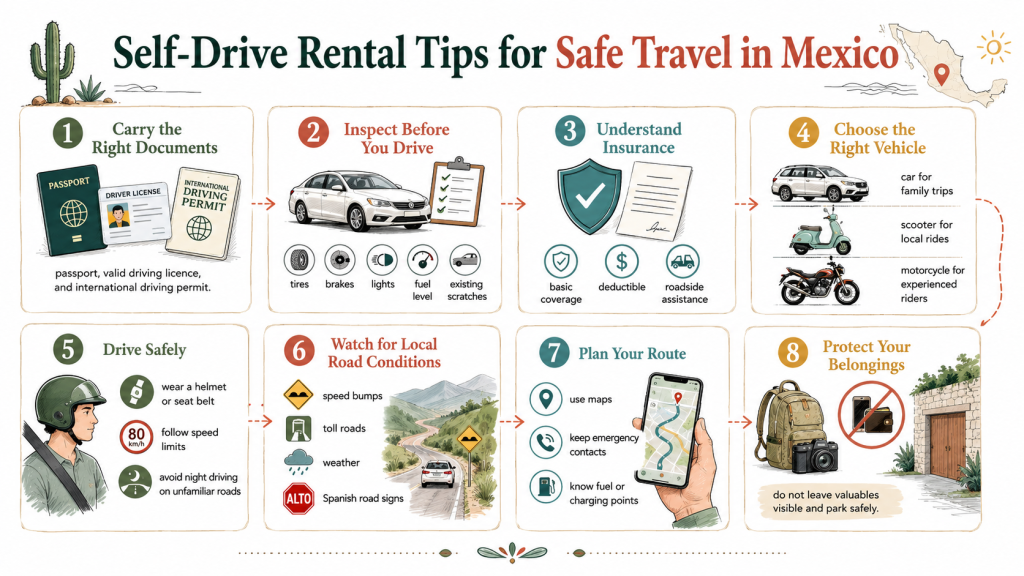
Safe travel begins with responsible preparation. Choose a vehicle that matches your skills, verify the driving-document requirements, understand the insurance, inspect the vehicle, photograph existing damage, follow local traffic rules, and avoid unfamiliar routes after dark. Indian travelers should pay particular attention to Mexico’s right-side driving system and allow time to adjust before beginning a long journey.
Whether you need a compact car for a family holiday, a scooter for local coastal travel, or a motorcycle for an experienced rider, compare the complete rental terms rather than selecting a vehicle only by its headline price.
Plan your next independent journey with MotoShare Mexico. Visit motoshare.mx to explore available rental options, compare suitable vehicles, and book transportation that matches your route, travel style, and budget.
