Introduction
For decades, the “Waterfall” model defined the IT landscape. It was a linear, rigid process characterized by long release cycles, massive documentation, and a high probability of catastrophic failure due to the total lack of feedback loops. When the Agile manifesto arrived, it successfully solved the “how we track work” problem, but it left a gaping hole in the “how we deploy work” problem. DevOps was the missing piece of the puzzle—the cultural and technical bridge that connected the creative process of development with the stability requirements of operations.
DevOps is no longer a luxury or a niche job title; it is a fundamental business survival strategy. Organizations that fail to automate their infrastructure, secure their pipelines, or observe their systems in real-time are accumulating technical debt that will eventually bankrupt them. The DevOps Certified Professional (DCP) is specifically designed to mold engineers into “Force Multipliers”—elite individuals who can take a raw piece of code and ensure it reaches the customer safely, securely, and at a massive global scale. This certification represents the transition from “it works on my machine” to “it works for millions of users worldwide.”
What is DevOps Certified Professional (DCP)?
The DevOps Certified Professional (DCP) is an elite, practitioner-level certification that validates an individual’s absolute mastery over the entire software delivery lifecycle (SDLC). It goes far beyond the surface-level “what” of popular tools and dives into the microscopic “how” of systemic automation, organizational psychology, and cross-functional culture.
While many entry-level certifications focus on a single cloud provider (like AWS) or a single tool (like Jenkins), the DCP is ecosystem-centric and vendor-neutral. It proves you understand the “Golden Path” of software delivery: how to seamlessly stitch together Version Control (Git), Continuous Integration (Jenkins/GitLab), Configuration Management (Ansible), Container Orchestration (Kubernetes), and Real-time Observability (Prometheus/Grafana) into a single, high-performance engine. It is the credential for those who want to be the architects of technical change, not just the passive users of a platform.
Why it Matters in Today’s Software, Cloud, and Automation Ecosystem
The modern tech stack is no longer a simple web server and a database. It is a sprawling, complex web of microservices, serverless functions, and multi-cloud clusters. Managing this without the DCP framework is akin to trying to fly a commercial jet without an instrument panel—it is dangerous and unsustainable.
- The Shift to Platform Engineering: Modern companies are moving away from manual “ticket-based” operations. They want internal developer platforms (IDPs) where developers can self-serve infrastructure. DCP provides the architectural skills required to build these internal systems.
- Digital Sovereignty and Automated Compliance: With strict data laws like GDPR and the Digital India Act, engineers must know how to automate compliance. DCP integrates “Policy as Code” mindsets directly into the deployment process, ensuring every release is legal by default.
- Infrastructure Evolution: We have moved from physical servers to Virtual Machines, and now to Containers, Serverless, and Ephemeral Infrastructure. DCP ensures you stay at the cutting edge of this evolution, preventing your skills from becoming obsolete in a fast-moving market.
- The AI-Augmented Lifecycle: As AI starts writing more code, the human role shifts toward managing the delivery and validation of that code. DCP holders are the ones who build the rigorous pipelines that vet and deploy AI-generated software.
Why Certifications are Important for Engineers and Managers
For the Individual Contributor (Engineer & Architect)
In an era where AI can assist in writing syntax, the value of an engineer has shifted toward Systems Thinking and Global Orchestration.
- Standardized Authority: A DCP badge on your profile signals to global recruiters that you have been vetted by industry experts and possess a standardized level of professional competence that is recognized across borders.
- Structured Mastery: Many engineers have “Swiss Cheese” knowledge—bits and pieces learned from YouTube or StackOverflow. DCP fills those holes with a structured, professional curriculum that covers the critical gaps you didn’t even know you had.
- Career Resilience: During economic shifts, companies retain the “engineers who can do everything.” A DCP holder is a versatile asset who can jump between dev, ops, and security seamlessly.
For the Leadership (Managers, Directors, & CTOs)
For those steering the corporate ship, the DCP is about Risk Mitigation and Predictability.
- Operational Excellence: When your team follows DCP standards, the number of “Production Outages” drops, and the “Mean Time to Recovery” (MTTR) improves significantly. This leads to higher customer satisfaction and better market reviews.
- Team Cohesion: It establishes a “Common Technical Language.” No more debates over “my custom script vs. your custom script”—everyone follows the industry-standard DCP workflow, making the team more interchangeable and less reliant on single points of failure.
- Talent Retention: Providing your team with DCP training shows a commitment to their professional growth, which is one of the highest drivers of employee retention in the modern tech sector.
Why Choose DevOpsSchool?
Selecting a training partner is a high-stakes decision that dictates your career trajectory. DevOpsSchool has established itself as the global leader for DCP aspirants due to its “Battle-Hardened” and practical approach to pedagogy.
- Project-First Methodology: They don’t just teach you the “Docker Build” command; they make you build a multi-tier microservices application and deploy it to a production-grade Kubernetes cluster with full logging and monitoring enabled.
- Real-World Instructors: The mentors are not full-time academics; they are active consultants who spend their days fixing real-world production pipelines for Fortune 500 companies and high-growth startups.
- Comprehensive Ecosystem: From initial learning and hands-on labs to certification and eventual job placement assistance, they provide a 360-degree ecosystem for career growth.
- Hyper-Updated Content: The tech world moves fast. DevOpsSchool’s DCP curriculum is updated every quarter to include new versions of tools and emerging best practices like GitOps, FinOps, and OPA.
About the Certification: DevOps Certified Professional (DCP)
What it is
The DCP is a comprehensive professional validation that certifies your capability to implement and manage modern DevOps methodologies. It focuses on breaking down organizational silos, automating manual toil (the “boring” stuff that causes burnout), and creating a culture of continuous feedback and incremental improvement.
Who should take it
This program is specifically tailored for a wide range of tech professionals:
- Software Developers who want to “own” the deployment and performance of their code.
- System Administrators transitioning from manual server management to “Infrastructure as Code.”
- QA Engineers moving toward “Continuous Testing” and automated quality gates.
- Technical Leads & Managers who need to oversee modern engineering departments and understand the mechanics of high-velocity delivery.
Skills You’ll Gain
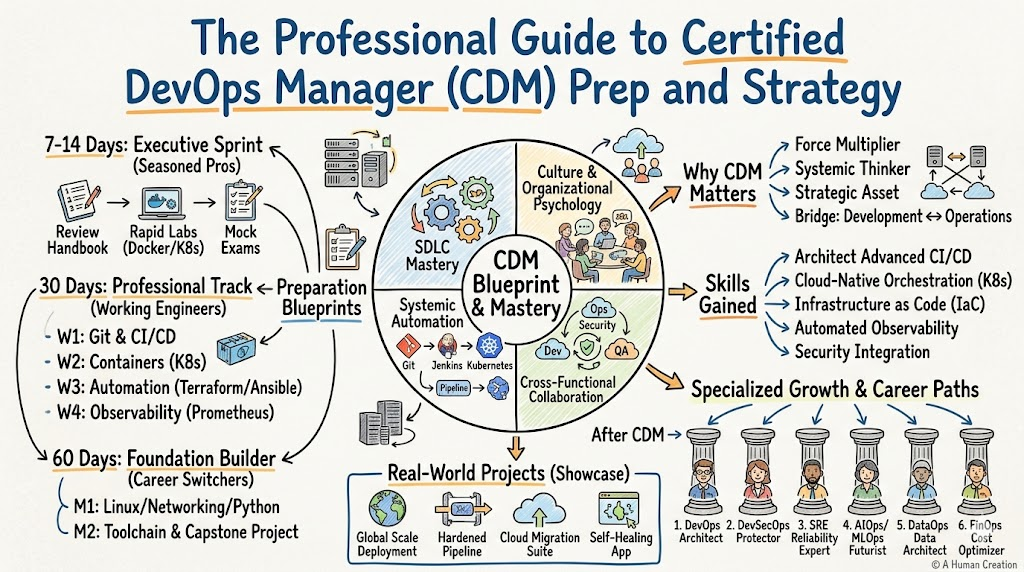
- Architecting Advanced CI/CD: Designing pipelines that are not just “fast” but also “resilient,” including auto-rollback and health-check capabilities.
- Advanced Containerization: Moving beyond basic Dockerfiles to multi-stage builds, rootless containers, and security-hardened images.
- Cloud-Native Orchestration: Mastering Kubernetes objects like Deployments, StatefulSets, Ingress Controllers, and Custom Resource Definitions (CRDs).
- Infrastructure as Code (IaC): Using Terraform to manage multi-cloud environments and Ansible for immutable server configurations.
- GitOps Mastery: Using Git as the “Single Source of Truth” for both application code and infrastructure state using tools like ArgoCD or Flux.
- Automated Observability: Implementing distributed tracing (Jaeger), structured logging (ELK), and proactive alerting (Prometheus/Grafana).
Real-World Projects You Should Be Able to Do
- The “Global Scale” Deployment: Deploying a high-availability web application across three different geographic regions (e.g., US-East, Mumbai, and London) simultaneously with automated DNS failover.
- The “Hardened” Pipeline: Building a CI/CD flow that automatically rejects any code containing hardcoded secrets, high-severity vulnerabilities, or performance regressions.
- The “Cloud Migration” Suite: Using Terraform to mirror an existing on-premise infrastructure in the cloud (AWS/Azure) in under 30 minutes with 100% accuracy.
- The “Self-Healing” App: Configuring a system where an application automatically detects a memory leak, restarts the failing service, and scales up new nodes during a massive traffic spike without human intervention.
The Master Certification Matrix (Global Industry View)
| Track | Level | Who it’s for | Prerequisites | Skills Covered | Order |
| DevOps | Professional | Engineers, Managers | Basic Linux, Git | CI/CD, K8s, Terraform, Docker | 1st |
| DevSecOps | Advanced | Security Teams | DCP Foundation | Vault, Snyk, Security as Code | 2nd |
| SRE | Advanced | Ops/Developers | DevOps Skills | SLOs, Error Budgets, Chaos Eng | 2nd |
| AIOps/MLOps | Specialized | Data Teams | Python, DevOps | ML Pipelines, Model Monitoring | 3rd |
| DataOps | Specialized | Data Engineers | SQL, DevOps | Data Lineage, ETL Automation | 3rd |
| FinOps | Management | Tech Leads/Finance | Cloud Basics | Unit Economics, Cost Control | 2nd |
Preparation Blueprints: Choose Your Pace
There is no “one size fits all” for technical learning. You must choose the plan that fits your current professional bandwidth and prior experience levels.
7–14 Days: The Executive Sprint (For Seasoned Pros)
- Phase 1 (Days 1-3): High-level review of the DevOps Handbook principles and advanced Git workflows (Rebase, Cherry-pick, and Trunk-based development).
- Phase 2 (Days 4-7): Rapid-fire labs on core container tools—Docker networking, volumes, and Kubernetes Pod scheduling logic.
- Phase 3 (Days 8-11): Focused study on Infrastructure as Code (Terraform providers) and Configuration Management (Ansible roles and playbooks).
- Phase 4 (Days 12-14): Intensive mock exams and troubleshooting scenarios (e.g., fixing a broken K8s cluster) to identify any remaining knowledge gaps.
30 Days: The Professional Track (For Working Engineers)
- Week 1: Mastery of the “Source.” Deep dive into Git-flow, CI/CD theory, and advanced Shell Scripting for automated system maintenance.
- Week 2: The “Container” Era. Moving from local Docker environments to managed Kubernetes services (EKS/GKE/AKS) and understanding the “Control Plane.”
- Week 3: Automation of Everything. Mastering Terraform modules and Ansible for server hardening, security patching, and application deployment.
- Week 4: The Feedback Loop. Setting up the “Observability Stack”—Prometheus for metrics, Grafana for visualization, and ELK for distributed logging.
60 Days: The Foundation Builder (For Career Switchers)
- Month 1: The Core Infrastructure. Focus entirely on Linux Administration, Networking (DNS, TCP/IP, Load Balancing), and Python for Automation. You cannot build a pipeline if you don’t know how the underlying server works.
- Month 2: The Toolchain Mastery. Spend 10 days each on CI/CD, Infrastructure, and Security/Monitoring. Finish the program with a multi-cloud “Capstone Project” that you can present during interviews as proof of your skills.
Common Pitfalls to Avoid
- The “Tutorial Hell” Trap: Don’t just watch videos at 2x speed. If you don’t type the commands yourself and break the system in the lab, you won’t learn how to fix it in production.
- Ignoring the “Ops” in DevOps: Many developers focus on the build but forget about backups, patching, and disaster recovery. A DCP professional must care about the “Run” phase of the lifecycle.
- Lack of Practical Context: If you can’t explain how a packet moves from a user’s browser to your Kubernetes pod through an Ingress controller, you aren’t yet ready for the DCP level.
The 6 Pillars of Specialized Growth
After completing your DCP, you are a powerful “Generalist.” To reach the top 1% of earners globally, you should specialize in one of these high-growth tracks:
- DevOps (The Architect): Managing the entire pipeline, platform engineering, and leading organizational transformation.
- DevSecOps (The Protector): Ensuring that “Security as Code” is a reality and that every build is hardened against modern cyber threats.
- SRE (The Reliability Expert): Using software engineering principles to ensure 99.99% uptime and managing the balance between speed and stability.
- AIOps/MLOps (The Futurist): Automating the lifecycle of Machine Learning models with the same rigor and speed as standard web applications.
- DataOps (The Data Architect): Building high-quality, automated data pipelines that ensure data is clean, accessible, and compliant.
- FinOps (The Cost Optimizer): Bridging the gap between engineering and finance to ensure that every dollar spent in the cloud provides maximum business value.
Career Mapping: Role → Recommended Certifications
| Role | Foundation | Intermediate | Advanced / Specialized |
| Cloud Engineer | DCP | AWS/Azure Solutions Architect | HashiCorp Terraform Associate |
| Security Engineer | DCP | DevSecOps Certified Professional | Certified Ethical Hacker (CEH) |
| Data Engineer | DCP | DataOps Certification | Apache Spark / Databricks |
| Engineering Manager | DCP | FinOps Certified | Agile Coach / PMP |
| Platform Engineer | DCP | Kubernetes Admin (CKA) | Service Mesh (Istio) Training |
| SRE | DCP | SRE Certified Professional | Chaos Engineering (Gremlin) |
Training Providers & Academic Support
DevOpsSchool
This provider is a leader in the DevOps education space, offering deep technical bootcamps and certification support for a global audience. They focus on providing hands-on labs that simulate real-world production environments, ensuring that students gain practical experience. Their instructors are seasoned industry veterans who provide mentorship beyond the curriculum, helping engineers solve actual work challenges during the training process.
Cotocus
A specialized training and consulting firm that focuses on high-end engineering practices and digital transformation. They provide tailored learning paths for enterprises and individuals looking to master complex toolchains. Their approach is highly practical, emphasizing the integration of security tools within existing workflows to achieve a true DevSecOps culture in large-scale organizations.
Scmgalaxy
As one of the largest communities for DevOps and SCM professionals, this provider offers a wealth of resources, including free tutorials and premium certification support. They are known for their community-driven approach to learning, where professionals can share insights and stay updated on the latest trends in software configuration and security automation.
BestDevOps
This platform offers curated training programs designed to help engineers move from foundational knowledge to advanced architectural mastery. They emphasize the career impact of certifications, providing students with the technical skills and the professional guidance needed to secure top-tier roles in the tech industry globally.
devsecopsschool.com
This is the official platform for the Certified DevSecOps Engineer program, offering direct access to the curriculum and certification exams. It provides a comprehensive ecosystem for learners, including study materials, practice labs, and official documentation. The site serves as the primary hub for professionals looking to validate their expertise through a recognized industry standard.
sreschool.com
Focusing on the intersection of reliability and security, this provider offers specialized training for Site Reliability Engineers. Their modules cover how to build resilient systems that can withstand both traffic spikes and security incidents. They provide deep dives into observability and automated response, which are critical for maintaining modern distributed systems.
aiopsschool.com
This provider is at the forefront of the AIOps movement, teaching engineers how to leverage artificial intelligence for IT operations. Their curriculum includes using AI to detect security threats and automate operational decision-making. It is an ideal resource for those looking to stay ahead of the curve in automated system management.
dataopsschool.com
A dedicated training site for data professionals who need to implement security and operations best practices within their data pipelines. They cover the unique challenges of securing large-scale data environments and ensuring compliance with global data protection laws through automation and rigorous testing.
finopsschool.com
This platform provides training on cloud financial management, helping professionals optimize their cloud spend while maintaining a secure infrastructure. They teach the essential skills of balancing cost, speed, and security, which is a growing requirement for modern cloud-native enterprises looking to maximize their ROI.
FAQs: Career & Certification Outcomes
1. Is the DCP focused on specific tools or general workflows?
It is workflow-centric. While you use tools like Docker and Terraform, the exam validates your ability to connect them into a repeatable system. It’s about “Flow,” not just “Commands.”
2. What is the single most important project to build for the DCP?
A full “Commit-to-Cloud” pipeline. This must include: code linting, unit testing, containerization, deployment to a cluster (like K8s), and an automated rollback if the health check fails.
3. Do I need to learn deep coding (like Java or C++)?
No. You need “Automation Scripting” skills. Focus on Bash for OS tasks, Python for utility scripts, and YAML/HCL for configuration and infrastructure.
4. How much daily practice is recommended for a 60-day goal?
Consistency beats intensity. Aim for 60–90 minutes daily. Spend 20% on theory and 80% in the terminal.
5. How does the “Professional” tag in DCP change my resume?
It signals that you are a “Strategic Asset.” You move from being a “Tool Operator” to an “Architect” who understands how automation impacts business speed and cost.
6. Can I take the DCP if I am currently a Manual Tester?
Yes. Your mindset for catching bugs is an asset. The DCP will teach you to turn those manual checks into “Quality Gates” within an automated pipeline.
7. Does the DCP help with remote or global job opportunities?
Yes. In 2026, DevOps is a universal language. Standardized skills in Kubernetes and GitOps are high-demand in the US, Europe, and India alike.
8. Is there a “Fast-Track” for the DCP if I already know Linux?
If you are already comfortable with the Linux CLI and Git, you can likely reduce your preparation time by 40%, focusing strictly on Orchestration (K8s) and IaC (Terraform).
9. Is this certification useful for Engineering Managers?
Highly. It helps managers identify bottlenecks, set realistic SLOs (Service Level Objectives), and understand the “Toil” their teams face, leading to better resource allocation.
10. What is the most common mistake candidates make during prep?
“Tool-Hopping.” Candidates often try to learn five different CI tools at once. It’s better to master one (like Jenkins or GitHub Actions) deeply, as the principles translate to all others.
11. How do I know I am truly “Exam Ready”?
You are ready when you can break a configuration (e.g., a networking error in K8s) and use logs/debugging tools to find the root cause without searching for a tutorial.
12. What is the best “next step” after achieving the DCP?
Pick a specialty pillar: DevSecOps if you enjoy security, SRE if you love high-scale reliability, or FinOps if you want to focus on cloud cost optimization.
FAQs: DevOps Certified Professional (DCP) Specifics
1. Is the DCP certification recognized by major MNCs?
Yes, major Multi-National Corporations recognize the DCP as a valid and standardized measure of professional competence in automation and high-velocity delivery.
2. What happens if I fail the first attempt of the exam?
Most reputable training providers offer a retake policy. You should use the detailed feedback from your first attempt to focus your studies on the specific modules where you were weak.
3. Does the DCP cover the latest AI-driven DevOps tools?
The curriculum is frequently updated. While it focuses on core DevOps principles, it often includes modules on how AI is being used to automate testing, log analysis, and predictive infrastructure monitoring.
4. Is the DCP exam entirely multiple-choice?
The exam generally features a mix of multiple-choice questions and complex, scenario-based problems that require deep technical analysis of architectural diagrams and command-line outputs.
5. Is there “Lifetime Access” to study materials?
Most providers, especially DevOpsSchool, offer lifetime access to their video recordings, lab guides, and community forums so you can stay updated as the tools evolve over the years.
6. Can I take the exam in my local time zone?
Yes, the certification exams are proctored online, allowing you to schedule them at your convenience (morning, evening, or weekend) regardless of your global location.
7. Do I need to be a Python expert to pass?
No, but you should have a “working knowledge” of scripting. You should be able to read a script, understand its logic, and modify it to suit your infrastructure needs.
8. What makes DCP different from a “DevOps Foundation” certificate?
A “Foundation” certificate is about definitions. The DCP (Professional) is about implementation. It is the difference between knowing what a “Container” is and knowing how to manage 100 containers in a production Kubernetes cluster.
Conclusion
The role of the “DevOps Professional” is one of the most exciting and rewarding paths in modern technology. It is a role that combines the creative problem-solving of development with the high-stakes discipline of operations. By pursuing the DevOps Certified Professional (DCP), you are not just gaining a title; you are gaining the capability to shape the future of how software is built, secured, and delivered to the world.
The bridge between “Code” and “Customer” is waiting to be built. Whether you are aiming for a higher salary, a more challenging role at a FAANG company, or the simple satisfaction of mastering your craft, the DCP is your roadmap to success.