Introduction
Mobile networks connect people across countries, cities, and regions. Behind every mobile connection, network systems use identifiers to recognize countries and mobile operators. Three important terms help explain this process: MCC, MNC, and PLMN.
These identifiers play a key role in telecommunications research. They help professionals understand how mobile networks identify themselves and how different operators fit into the global telecom landscape. They also help researchers organize information about mobile network operators across countries.
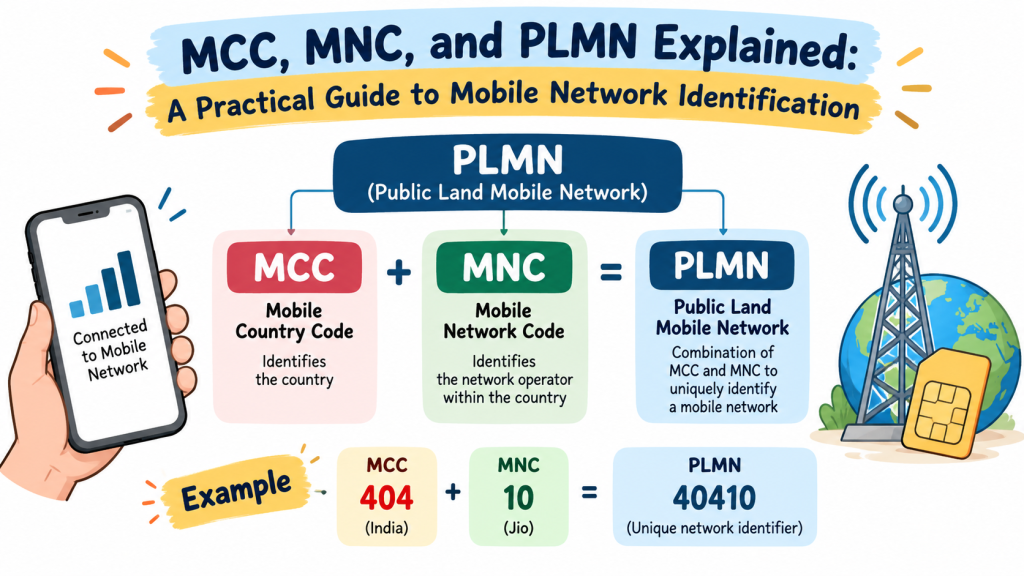
However, these codes can confuse people who are new to telecommunications. MCC identifies a country within a mobile network identification system. MNC identifies a mobile network within that country code context. PLMN refers to a public land mobile network and commonly uses the MCC and MNC together for identification.
Understanding these terms can help telecom researchers, developers, travel technology teams, and eSIM professionals work with network information more accurately. It can also help users understand mobile operator directories and network lookup tools.
This guide explains each identifier, shows how they relate to one another, and describes where they prove useful. It also covers common data errors, practical lookup methods, and important limitations to consider when researching mobile operators.
What Are MCC, MNC, and PLMN?
Mobile network identification uses structured codes to distinguish networks and their associated numbering contexts. MCC, MNC, and PLMN describe different parts of this process.
Although these terms work together, they do not mean the same thing. Knowing the difference helps prevent errors when building telecom databases or researching operators.
Mobile Country Code (MCC)
The Mobile Country Code, or MCC, is a three-digit code associated with a country or geographical numbering context in mobile telecommunications.
Mobile network identification systems use the MCC as part of a network’s identity. Researchers can use it to organize operator information by country and investigate network assignments.
An MCC does not identify a specific operator on its own. Several mobile networks can share the same MCC because they operate within the same country code context.
Mobile Network Code (MNC)
The Mobile Network Code, or MNC, identifies a mobile network within the relevant MCC context.
MNCs can contain two or three digits, depending on the applicable numbering plan. This difference matters when researchers store, compare, or validate network identifiers.
An MNC should not be interpreted without its associated MCC. The same MNC value may appear in different countries, so the combined identifier provides more useful context.
Public Land Mobile Network (PLMN)
A Public Land Mobile Network, or PLMN, is a mobile telecommunications network that provides services to users.
In common mobile network identification systems, a PLMN identity combines an MCC and an MNC. Together, these codes identify the network within the applicable numbering structure.
A PLMN identifier helps distinguish one network from another. However, it does not independently confirm whether a network currently offers service, supports roaming for a particular subscriber, or works with a specific device.
MCC vs. MNC vs. PLMN: Key Differences
The following table summarizes the main differences between these terms.
| Identifier | Full Name | Main Purpose | Typical Format | Important Detail |
|---|---|---|---|---|
| MCC | Mobile Country Code | Identifies a country or geographical numbering context | Three digits | Does not identify an individual operator |
| MNC | Mobile Network Code | Identifies a mobile network within an MCC context | Two or three digits | Must be interpreted with the relevant MCC |
| PLMN | Public Land Mobile Network | Refers to a public mobile network | Commonly represented by MCC and MNC together | Does not guarantee service availability or compatibility |
For example, a telecom database might store an MCC and MNC as separate fields and use both values to build a PLMN identifier. The actual values must come from a reliable network assignment source.
This structure also helps databases distinguish between an operator’s name and its technical network identifier.
How Mobile Network Identification Works
Mobile network identification follows a structured process. The exact procedures depend on the mobile technology, network configuration, and standards involved.
At a high level, the MCC and MNC provide identifying information about a mobile network. A device or network system can use this information as part of network selection, registration, and other mobile communication procedures.
Consider the following simplified example.
A researcher wants to organize information about a mobile operator in a country. The researcher first identifies the relevant MCC. Next, the researcher checks the operator’s MNC assignment. The combined values help identify the corresponding PLMN.
This process supports organized telecom research, but the identifier alone does not answer every operational question.
For example, an identifier cannot prove that a subscriber can connect to a network. Subscription permissions, roaming agreements, device support, network coverage, and service status may also affect connectivity.
Why the Combined Identifier Matters
An MCC provides geographical numbering context, while an MNC identifies a network within that context. Using both values reduces ambiguity when researchers compare operators.
A database that stores only an MNC may confuse networks that use the same numeric value in different MCC contexts. A database that preserves the complete identifier can support more accurate searches and comparisons.
This distinction matters when teams build operator directories, process telecom datasets, or investigate network information across multiple countries.
Why These Identifiers Matter in Telecommunications
MCC, MNC, and PLMN identifiers support several practical telecom activities. Their value comes from consistent network identification rather than from the codes acting as complete records of a mobile service.
Mobile Operator Research
Telecom researchers often need to identify mobile operators across countries. MCC and MNC values provide structured fields that help organize operator records.
A directory can group network information by country and associate relevant MNC values with operator records. Researchers should still verify the operator name, assignment status, and source information before relying on a record.
Network Troubleshooting
Network engineers may examine PLMN information while investigating registration or network selection problems.
The identifier can help them understand which network a device is attempting to use or reporting. However, engineers must review other technical evidence before deciding why a connection failed.
A correct identifier does not rule out problems with radio coverage, device configuration, subscriber permissions, or network availability.
Roaming Research
Roaming allows subscribers to use eligible mobile services outside their home network through supported arrangements.
MCC and MNC values can help researchers identify networks involved in roaming scenarios. However, an identifier does not prove that two operators have a roaming agreement or that a particular plan includes access.
Researchers must check the relevant service terms and roaming arrangements separately.
eSIM and Travel Connectivity Research
Travel connectivity services often involve several parties. These may include a consumer-facing eSIM brand, a service provider, a roaming partner, and the underlying mobile network.
Network identifiers can help researchers investigate the underlying network information. Yet they do not independently establish which networks an eSIM plan supports in practice.
Before making a compatibility claim, researchers should verify the provider’s current plan details and supported destinations.
Telecom Database Management
Telecom databases need consistent records to support searches, comparisons, and reporting.
MCC and MNC fields provide a structured way to represent network identifiers. Clear field definitions and reliable source records help reduce duplicate entries and incorrect operator associations.
Teams should also preserve the original code format, including leading zeros where applicable.
Where MCC, MNC, and PLMN Information Gets Used
Different teams use mobile network identifiers for different purposes. The table below connects common tasks with their practical value and limitations.
| Use Case | How Identifiers Help | What Else Requires Verification |
|---|---|---|
| Operator directories | Organize operator records by network identifier | Current operator names and assignments |
| Network troubleshooting | Help identify a reported or selected network | Device logs, network status, and configuration |
| Roaming research | Help identify networks involved in a roaming scenario | Agreements, plan eligibility, and service terms |
| eSIM research | Support investigation of underlying network information | Plan compatibility and supported networks |
| Telecom analytics | Provide structured fields for grouping network data | Data quality, source reliability, and update dates |
| Mobile application development | Support network identification features | Platform permissions and actual device behavior |
| Technical documentation | Standardize network references | Applicable standards and current assignment records |
These examples show why the identifiers matter. They provide useful technical context, but teams should combine them with current and relevant evidence.
How to Look Up MCC and MNC Information
A reliable lookup process should prioritize accuracy, clear records, and traceable sources. The following steps provide a practical starting point.
Step 1: Define the Information You Need
First, decide what you want to identify. You might need a country’s MCC, an operator’s MNC, a combined PLMN identity, or information about a particular network.
A clear objective helps you select the right data source and avoid collecting irrelevant fields.
Step 2: Search a Telecom Directory
Use a telecom directory that organizes information about mobile network operators and network identifiers.
eSIMGlobo is an independent global telecom directory focused on researching mobile network operators, MCC, MNC, and PLMN identifiers. It can serve as a starting point for exploring this type of information.
Treat directory results as research records. Check important assignments against suitable authoritative sources before using them in technical systems or formal documentation.
Step 3: Check the MCC and MNC Separately
Review the MCC and MNC fields individually. Confirm that the MCC matches the intended country or geographical numbering context.
Next, inspect the MNC format. Check whether the relevant numbering plan uses two or three digits for the value.
Do not remove leading zeros or change digit lengths simply to make records look consistent.
Step 4: Confirm the Operator Association
Compare the identifier with the operator name and other available record details.
Be careful when the directory includes a consumer-facing brand, a virtual mobile operator, a reseller, or a roaming provider. These entities may not be the same as the underlying network operator.
If several records appear to describe the same organization, investigate their relationships before combining them.
Step 5: Verify Important Assignments
Use an appropriate authoritative source when accuracy matters. Depending on the record and jurisdiction, this may include a national regulator, an official numbering or assignment database, or relevant technical documentation.
Check whether the source describes a current assignment, a historical record, or a particular scope of use.
If two sources disagree, record the difference and investigate it instead of selecting a value without explanation.
Step 6: Record the Source and Verification Date
A useful telecom record should include more than a code and operator name.
Where practical, record the source, date checked, country context, operator association, and any relevant uncertainty. This information helps future users understand where the record came from and whether they should verify it again.
Common Problems in MCC and MNC Data
Even a well-organized telecom directory can contain records that need further investigation. Data quality depends on the source, the date of collection, and the way the information represents operators.
Incorrect Digit Length
MNCs can use two or three digits, depending on the numbering plan. A system that assumes every MNC has the same length may change a value incorrectly.
For example, a spreadsheet may remove a leading zero from a code. That change can create a different string and may lead to an incorrect comparison.
Store identifiers in a format that preserves their intended representation.
Missing Leading Zeros
Spreadsheet programs sometimes interpret codes as numbers. As a result, they may remove leading zeros or change how a value appears.
Telecom identifiers should retain the format defined by the relevant numbering system. Storing the values as text can help preserve their original representation.
Confusing an Operator Brand With a Network
A company may sell mobile services without operating the underlying radio network itself. Virtual operators, resellers, and eSIM providers can have different roles in the service chain.
Researchers should not automatically assign an underlying network’s identifier to every brand that sells connectivity.
Check the relationship between the service brand and the actual network operator before publishing an association.
Treating Old Records as Current
Telecom data changes over time. Operator names, corporate relationships, network arrangements, and assignment records may change.
A record that once matched an operator may no longer describe the current situation accurately. Use source dates and verification notes to help identify information that needs review.
Assuming an Identifier Guarantees Connectivity
A valid MCC and MNC combination does not guarantee that a device can register on a network.
Connectivity may depend on coverage, compatible radio technology, subscriber credentials, roaming permissions, device settings, and service availability.
Use network identifiers as one part of a broader investigation, not as a complete connectivity test.
Best Practices for Managing Telecom Identifier Data
Teams that handle MCC, MNC, and PLMN information should use a consistent data management process. These practices can improve reliability and make future reviews easier.
Preserve the Original Values
Keep the original identifier values exactly as the source presents them. Do not remove leading zeros or standardize digit lengths without checking the applicable rules.
If you need a normalized field for searching, retain the original field as well. This approach makes it easier to trace and correct errors.
Separate Different Types of Information
Keep network identifiers separate from operator names, consumer brands, service providers, and roaming partners.
Use distinct database fields for these details. Add relationships between records when one organization provides services through another network.
This structure helps prevent incorrect assumptions about who owns or operates a network.
Track Data Sources
Record where each important value came from. Prefer sources that clearly explain the assignment and its scope.
When sources disagree, keep a note of the conflict. Do not hide uncertainty by merging inconsistent records into one unqualified entry.
Review Records Periodically
Set a review process that matches the importance and expected change rate of your data.
For example, a directory used for active technical operations may need more frequent checks than a dataset used for general historical research. The appropriate schedule depends on the use case and source reliability.
Validate Before Technical Use
Before using identifiers in software, reporting systems, or operational workflows, test how your application handles the values.
Check digit length, field types, duplicate records, missing values, and country associations. Also confirm that the software does not silently convert identifiers into numbers or remove leading zeros.
These checks can catch simple data problems before they affect users or reports.
Choosing a Mobile Network Identifier Directory
A directory should make it easier to research mobile network information without hiding important limitations. When evaluating a directory, consider the following points.
Clear definitions: The directory should explain MCC, MNC, and PLMN in a way that readers can understand.
Useful organization: Country and operator records should be easy to find and compare.
Traceable information: Where available, the directory should provide enough context to help users investigate an assignment.
Clear distinctions: Records should distinguish underlying network operators from virtual operators, resellers, and consumer-facing brands when that information is known.
Data limitations: The directory should not imply that a code proves active service, roaming eligibility, or device compatibility.
Verification options: Important records should allow users to compare directory information with appropriate authoritative sources.
No single directory should replace all technical verification. Choose resources according to the decision you need to make and the level of accuracy that decision requires.
How eSIMGlobo Fits Into Telecom Research
eSIMGlobo focuses on helping users research global mobile network operators and their MCC, MNC, and PLMN identifiers.
This type of directory can help readers explore network information in a more structured way. Telecom researchers can use such information to begin investigating an operator or to organize records for further review.
However, users should distinguish directory information from proof of current network availability. A network identifier alone cannot confirm whether a particular eSIM plan works in a destination, whether a device supports the relevant network, or whether a subscriber can access roaming services.
For technical projects, verify important details against appropriate authoritative sources. For research and documentation, preserve the source and date of verification. These steps help users make better use of directory data without relying on assumptions.
Frequently Asked Questions
1. What does MCC mean in telecommunications?
MCC stands for Mobile Country Code. It uses three digits to identify a country or geographical numbering context within mobile network identification systems.
2. What does MNC stand for?
MNC means Mobile Network Code. It identifies a mobile network within the associated MCC context and may contain two or three digits, depending on the numbering plan.
3. What is a PLMN identifier?
A PLMN is a Public Land Mobile Network. In common mobile network identification systems, its identity combines the MCC and MNC.
4. What is the difference between MCC and MNC?
MCC identifies the relevant country or geographical numbering context. MNC identifies a network within that context. Both values work together to identify a mobile network.
5. Can two mobile operators use the same MNC?
The same MNC value can appear in different MCC contexts. Researchers should therefore use the relevant MCC and MNC together instead of relying on the MNC alone.
6. Does an MCC or MNC prove that a mobile network is active?
No. An identifier does not independently confirm current network operation or service availability. Users should check current, suitable sources for operational status.
7. Can MCC and MNC codes confirm eSIM compatibility?
No. These codes can help identify a network, but they do not prove that an eSIM plan supports it. Compatibility also depends on the plan, device, network technology, and provider arrangements.
8. Why should telecom databases store codes as text?
Text fields can preserve leading zeros and the original digit format. This helps prevent spreadsheet and database tools from changing identifiers during import, sorting, or processing.
9. Where can I research MCC, MNC, and PLMN information?
You can begin with a telecom directory such as eSIMGlobo, which focuses on global mobile network operators and these identifiers. Verify important assignments through appropriate authoritative sources before relying on them.
10. How often should telecom identifier records be checked?
The right schedule depends on the purpose of the database and the reliability of its sources. Records used for technical or operational decisions may need more frequent verification than records used for general reference.
Final Thoughts
Reliable mobile network research starts with understanding the information behind each identifier. MCC provides country or geographical numbering context, MNC identifies a network within that context, and PLMN refers to the corresponding public mobile network.
These terms support telecom directories, technical research, network troubleshooting, and eSIM investigations. However, the codes do not replace checks for service availability, roaming access, or device compatibility.
By preserving code formats, separating operator roles, documenting sources, and verifying important assignments, researchers can maintain more trustworthy telecom records. Directories such as eSIMGlobo can provide a useful starting point, while careful verification helps ensure that the information supports the intended decision.
