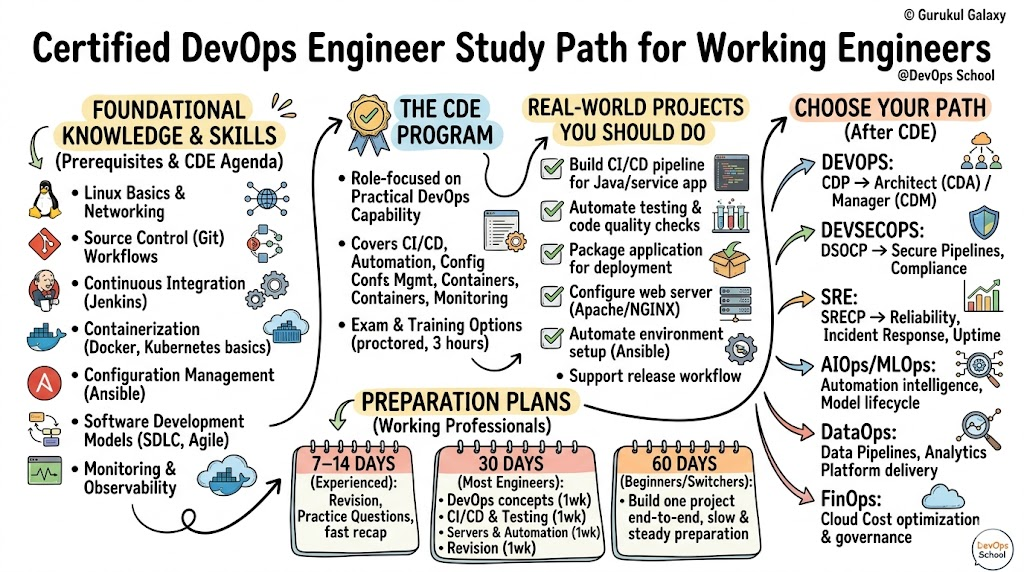
The Certified DevOps Engineer (CDE) certification is designed for professionals who want to prove that they can build, automate, and improve modern software delivery systems. On the DevOpsSchool certification page, it is described as a program focused on CI/CD pipelines, infrastructure automation, configuration management, monitoring, and real-world DevOps problem solving, with expected familiarity in tools such as Jenkins, Docker, Kubernetes, Git, and Ansible.
For working engineers and managers, this certification matters because DevOps is no longer just about using a few tools. Teams now need people who can connect development, testing, deployment, operations, reliability, and automation into one working delivery model. The CDE certification is aimed at validating that practical capability, and DevOpsSchool positions it for DevOps Engineers, Cloud Engineers, and SREs.
According to the DevOpsSchool page, the CDE is available as a 3-hour exam-only certification and also as a training program, with online-proctored delivery and English as the exam language. The same page also states that the exam prerequisite is tied to the Master in DevOps Engineering (MDE) training path.
Why this certification is important
A DevOps Engineer is expected to do more than write build scripts. In real companies, the role often includes source control workflows, continuous integration, containerization, deployment automation, environment standardization, reliability checks, monitoring, release support, and collaboration across teams. The published CDE agenda reflects that wide scope by covering software development models, DevOps concepts, DevSecOps, SRE, CI/CD/CM, organizational culture, and transition planning.
The deeper curriculum shown on the certification page also includes hands-on areas such as Maven, JUnit, Selenium, Jacoco, Apache HTTP, NGINX, and Ansible, which suggests that the program is not limited to theory. It is built around the kind of stack many teams still work with in enterprise delivery pipelines.
That makes CDE useful for three types of people:
- engineers moving from traditional system administration or development into DevOps,
- DevOps practitioners who want formal validation,
- managers who want a structured benchmark for team capability.
Certification overview table
| Track | Level | Who it’s for | Prerequisites | Skills covered | Recommended order |
|---|---|---|---|---|---|
| DevOps | Engineer | DevOps Engineers, Cloud Engineers, SREs | Strong foundation in Jenkins, Docker, Kubernetes, Git, Ansible; DevOpsSchool also lists MDE as the prerequisite path | CI/CD, infrastructure automation, config management, monitoring, DevOps workflows | After foundational DevOps learning or MDE |
Source basis for this table comes from the official CDE page sections on certification overview, audience, prerequisite, and agenda.
What it is
Certified DevOps Engineer is a role-focused certification for people who want to validate practical DevOps capability. It is positioned as a program that tests both knowledge and hands-on understanding of delivery pipelines, automation, containers, configuration management, and monitoring.
Who should take it
This certification is a strong fit for:
- DevOps Engineers
- Cloud Engineers
- Site Reliability Engineers
- Build and Release Engineers
- Platform team members
- Experienced software engineers moving toward automation and cloud delivery roles
Skills you’ll gain
- Understanding of DevOps principles, process flow, and team collaboration
- CI/CD and continuous monitoring concepts
- Working knowledge across delivery tooling and automation
- Build and test automation exposure through Maven, JUnit, Selenium, and Jacoco
- Web and runtime environment understanding through Apache and NGINX
- Configuration and deployment management through Ansible
- Broader understanding of DevSecOps and SRE context inside software delivery
Real-world projects you should be able to do after it
- Build a CI pipeline for a Java or service-based application
- Automate testing and code quality checks in the pipeline
- Package applications and prepare deployment-ready artifacts
- Configure basic web server hosting with Apache or NGINX
- Automate environment setup and deployment using Ansible
- Support a release workflow with versioning, test execution, and rollback thinking
- Participate in a DevOps transformation discussion with better clarity on culture and operating model
Preparation plan
7–14 days
Good for experienced engineers who already work with CI/CD, Git, containers, and automation. Focus on revision, practice questions, terminology, and fast recap of the CDE tool areas. This is realistic only if you already use these tools in production. The official page itself expects a strong foundation in core DevOps tools.
30 days
Best for most working engineers. Spend one week on DevOps concepts and SDLC, one week on CI/CD and testing, one week on servers, automation, and deployment management, and one week on revision plus mocks. This aligns well with the published agenda breadth.
60 days
Best for career switchers, support engineers, sysadmins, or developers with limited DevOps exposure. Use the extra time to build one small project end to end: source control, build, test, package, deploy, configure, monitor. Since the certification covers multiple practical areas, slow-and-steady preparation is often the best route.
Common mistakes
- Studying tools in isolation without understanding the flow from code to production
- Memorizing definitions without building one real pipeline
- Ignoring testing automation and focusing only on deployment
- Not revising Apache, NGINX, or Ansible basics
- Underestimating the DevSecOps and SRE context mentioned in the curriculum
- Assuming experience alone is enough without structured revision
Best next certification after this
A sensible next step depends on your goal:
- Same track: Certified DevOps Professional (CDP)
- Cross-track: Site Reliability Engineering Certified Professional (SRECP) or DevSecOps Certified Professional (DSOCP)
- Leadership: Certified DevOps Architect (CDA) or Certified DevOps Manager (CDM)
These certification names and track options are listed in the Gurukul Galaxy software engineer certification roundup.
Choose your path
DevOps path
A practical path is: Certified DevOps Engineer → Certified DevOps Professional → Certified DevOps Architect / Certified DevOps Manager. The Gurukul Galaxy guide lists these credentials together, which makes them a natural same-track progression.
DevSecOps path
A good security-focused path is: Certified DevOps Engineer → DevSecOps Certified Professional → Certified DevSecOps Engineer / Architect. This works well for engineers who already understand delivery flow and want to shift security left.
SRE path
A reliability-focused path is: Certified DevOps Engineer → Site Reliability Engineering Certified Professional → Certified Site Reliability Architect. Since CDE already touches SRE concepts in the agenda, this is a strong transition for those moving toward reliability ownership.
AIOps/MLOps path
For engineers interested in data-driven operations and ML-powered delivery systems, a good route is: Certified DevOps Engineer → AiOps Certified Professional / MLOps Certified Professional → architect-level specialization later. The Gurukul Galaxy guide places both AIOps and MLOps certifications in the broader software engineer growth map.
DataOps path
For data platform or analytics delivery roles: Certified DevOps Engineer → DataOps Certified Professional or DataOps Engineer-style path → DataOps Architect/Manager. This is useful when you work on data pipelines, analytics platforms, or governed data delivery workflows.
FinOps path
For cloud cost ownership and governance roles: Certified DevOps Engineer → Certified FinOps Engineer / Professional → Certified FinOps Architect / Manager. This is especially useful for engineers or managers responsible for cloud usage efficiency.
Role → Recommended certifications
| Role | Recommended certifications |
|---|---|
| DevOps Engineer | Certified DevOps Engineer, Certified DevOps Professional, KCAD |
| SRE | Certified DevOps Engineer, SRECP, Certified Site Reliability Architect |
| Platform Engineer | Certified DevOps Engineer, KCAD, Certified DevOps Architect |
| Cloud Engineer | Certified DevOps Engineer, AWS DevOps Engineer – Professional, Azure DevOps Engineer Expert, GCP Professional Cloud DevOps Engineer |
| Security Engineer | Certified DevOps Engineer, DevSecOps Certified Professional, Azure Security Engineer Associate (AZ-500), AWS Certified Security – Specialty |
| Data Engineer | Certified DevOps Engineer, DataOps Certified Professional / Engineer path, AWS Certified Data Engineer – Associate, Azure Data Engineer, GCP Professional Data Engineer |
| FinOps Practitioner | Certified DevOps Engineer, Certified FinOps Engineer, Certified FinOps Professional |
| Engineering Manager | Certified DevOps Engineer, Certified DevOps Manager, Certified DevOps Architect, Certified FinOps Manager |
These recommendations are built from the certification families listed in the Gurukul Galaxy roundup and from the CDE positioning toward DevOps, Cloud, and SRE practitioners.
Next certifications to take
Same track
Certified DevOps Professional (CDP)
Take this if you want deeper DevOps maturity after proving engineer-level capability. It is the most logical direct continuation in the same family.
Cross-track
Site Reliability Engineering Certified Professional (SRECP) or DevSecOps Certified Professional (DSOCP)
Choose SRECP if your future is uptime, observability, resilience, and incident reduction. Choose DSOCP if you want stronger security integration in delivery.
Leadership
Certified DevOps Architect (CDA) or Certified DevOps Manager (CDM)
Choose architect if you design delivery platforms and enterprise DevOps models. Choose manager if you lead people, process, governance, and transformation outcomes.
Choose Your Path
DevOps Path
Start with Certified DevOps Engineer and then go deeper into DevOps implementation, advanced delivery practices, architecture, and transformation. This is the best path for people who want to stay close to automation, CI/CD, containers, and platform delivery.
DevSecOps Path
Choose this path if you want to bring security into pipelines, release flow, and engineering operations. It is ideal for engineers who want to work on secure automation, compliance-aware delivery, and shift-left practices.
SRE Path
This path is best if you care more about uptime, reliability, incident response, observability, and production performance. It builds naturally after DevOps basics.
AIOps / MLOps Path
This path is useful for engineers working with intelligent operations, machine learning delivery, operational analytics, and automation at scale.
DataOps Path
This path is meant for professionals working with data pipelines, orchestration, quality checks, analytics delivery, and governed data workflows.
FinOps Path
This path is strong for cloud and platform professionals who want to combine engineering thinking with cost control, cloud usage visibility, and financial accountability.
FAQs on the broader certification journey
1. Is Certified DevOps Engineer difficult?
It is moderate to challenging for beginners because it expects familiarity with multiple tools and delivery practices. The official page explicitly mentions strong foundations in Jenkins, Docker, Kubernetes, Git, and Ansible.
2. Can a software developer take this certification?
Yes. A developer with interest in automation, CI/CD, containers, and release engineering can take it, especially if they want to move closer to platform or DevOps work. The coverage is practical enough for engineers coming from development.
3. Is this for freshers?
It is better suited to people with at least some exposure to software delivery, Linux, cloud, or automation. Freshers can still prepare for it, but the 60-day route is usually safer. This is an inference from the breadth of the syllabus and the expected tool familiarity.
4. How much time should I give?
If you already work in DevOps, 2 to 4 weeks may be enough. If you are transitioning from another role, 6 to 8 weeks is more practical. The agenda breadth supports that preparation range.
5. Do I need Kubernetes knowledge?
Yes, at least a working foundation helps. Kubernetes is named among the expected foundational tools on the official page.
6. Is this more tool-based or concept-based?
It is both. The page includes concepts such as DevOps, DevSecOps, SRE, SDLC models, and culture, while also covering practical tools and workflows.
7. Should I do DevOps or SRE after this?
Choose DevOps if you enjoy platform automation and delivery improvement. Choose SRE if you care more about reliability, SLIs/SLOs, incident reduction, and operability. The official CDE agenda already introduces SRE concepts, so both directions are valid.
8. Is it useful for managers?
Yes, especially engineering managers and platform leaders who need to understand delivery maturity, automation readiness, and skill mapping for their teams. Manager-level next certifications are also listed in the broader certification guide.
Conclusion
Certified DevOps Engineer is a strong certification for professionals who want to show they can do real DevOps work, not just talk about tools. Its official scope covers delivery concepts, CI/CD, automation, testing, configuration management, monitoring, and practical infrastructure topics, which makes it useful for engineers who want a serious career move into DevOps, cloud, SRE, or platform work. If your goal is to build credibility, structure your learning, and create a clear next step toward higher certifications in DevOps, DevSecOps, SRE, AIOps, DataOps, or FinOps, CDE is a solid starting point.
Leave a Reply