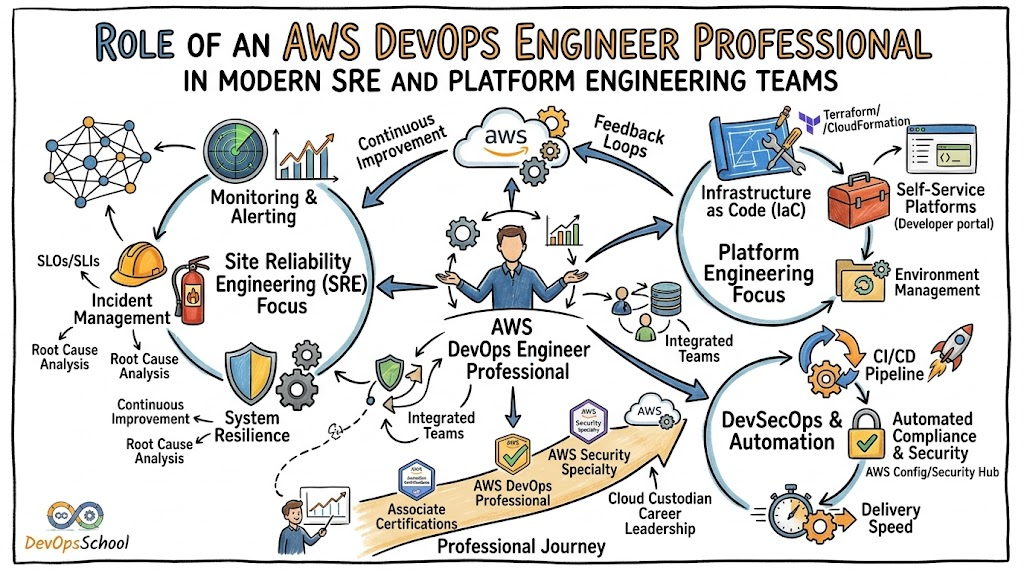
Introduction
The nature of technological gravity has shifted. In the previous decade, the primary challenge for any organization was simply moving to the cloud. Today, the challenge is staying there safely. We have moved from an era of “Cloud Adoption” to an era of “Cloud Governance and Resilience.”
For engineers and managers—whether you are operating in the high-density tech corridors of India or leading global distributed teams—the definition of a “Senior Engineer” has been rewritten. It is no longer sufficient to build a system that scales; you must build a system that defends itself. Identity has become the new perimeter, and automation is the only tool capable of defending it at scale. This guide is your tactical blueprint for achieving mastery in this new world, centered on the AWS Certified Security – Specialty program.
Overview of the AWS Security Specialty Credential
The AWS Certified Security – Specialty credential highlights professionals who can build and run well‑protected solutions on AWS. It focuses on your ability to design secure architectures, define and enforce precise access controls, and safeguard critical data using appropriate encryption and key management techniques. The exam also evaluates how you structure network protection in multi‑account environments, set up meaningful logging and monitoring, and use security services to spot and respond to suspicious activity. Earning this certification shows that you can support an organisation in operating sensitive, high‑value workloads on AWS with a security approach that is both practical and resilient.
Why Security is the Pulse of Modern Automation
In current landscape software ecosystem, the boundary between “Dev” and “Sec” has effectively vanished. With the explosion of generative AI in coding and the total dominance of serverless and containerized microservices, the surface area for potential risk is infinite.
Manual security checks are no longer just slow; they are obsolete. If your deployment pipeline can push code in sixty seconds, your security protocol cannot take sixty minutes. This is why DevSecOps and AIOps have moved from the fringe to the core of every enterprise strategy. Businesses are no longer hiring “Security Guards”; they are hiring “Security Architects”—professionals who can write the code that protects the code.
For a manager, investing in cloud security certification is the ultimate insurance policy. It ensures that the team is not just moving fast, but moving with the “Safe Velocity” required to protect the brand’s integrity and the customers’ data in a world where a single misconfiguration can lead to a global outage.
The DevOpsSchool Advantage
DevOpsSchool has redefined the educational model by moving away from passive consumption and toward Practitioner-Led Mentorship.
At DevOpsSchool, the philosophy is simple: you cannot secure what you do not understand. Their curriculum doesn’t just prepare you for a 65-question exam; it prepares you for a 3:00 AM production incident. By focusing on deep-dive labs, real-world case studies, and the “why” behind every AWS configuration, they ensure that their students emerge not just as certificate holders, but as domain experts. For an employer, a candidate from DevOpsSchool represents a lower “time-to-productivity,” which is the most valuable metric in today’s hiring market.
AWS Certified Security – Specialty Landscape
| Track | Level | Ideal For | Prerequisites | Skills Covered | Order |
| Security | Specialty | Security Leads, DevSecOps Engineers | 2+ Years AWS Exp | Encryption, IAM, Governance, Forensics | Step 3/4 |
| DevOps | Professional | SREs, Automation Leads | Associate Knowledge | CI/CD, SDLC, HA, Monitoring | Step 4 |
| Solutions Architect | Professional | Principal Architects | Solutions Architect Assoc. | Multi-account Governance, Migration | Step 4 |
| Developer | Associate | App Developers | Basic Cloud Logic | SDKs, Serverless, Lambda, DynamoDB | Step 2 |
| SysOps | Associate | SREs, Cloud Admins | Basic IT Knowledge | Operations, Scaling, Health Monitoring | Step 2 |
Technical Deep Dive: AWS Certified Security – Specialty (SCS-C02)
What it is
The AWS Certified Security – Specialty is an elite credential designed to validate your ability to protect the entire AWS environment. It moves beyond standard infrastructure to cover advanced cryptography, incident response, and automated compliance at a global scale.
Who should take it
This certification is essential for anyone who wants to hold “Security” in their job title. It is also highly recommended for Senior DevOps Engineers who want to specialize in the “Sec” part of the pipeline and Architects who need to design systems for regulated industries (Fintech, Healthcare, Govt).
Skills you’ll gain
- Identity Orchestration: Master-level control over IAM, SCPs, and Permission Boundaries.
- Cryptographic Agility: Managing the rotation, policy, and usage of AWS KMS and CloudHSM.
- Infrastructure Hardening: Implementing VPC Endpoints, WAF, and Shield for zero-trust networks.
- Proactive Threat Hunting: Utilizing GuardDuty, Macie, and Security Hub to find anomalies.
- Forensic Auditing: Building audit trails with CloudTrail, Config, and Athena for deep-log analysis.
Real-world projects you should be able to do after it
- Automated Forensic Capture: Build a system that snapshots an EC2 instance, revokes its IAM credentials, and isolates it in a “Sandbox VPC” the moment a threat is detected.
- Zero-Trust File Storage: Design a system where every S3 object is encrypted with a unique key, and access is only granted via short-lived, pre-signed URLs.
- Compliance-as-Code Dashboard: Create a real-time monitor using AWS Config that alerts stakeholders if any S3 bucket or database is made public.
- The “Kill-Switch” Workflow: Implement a Lambda-based system that automatically terminates any user session that attempts to perform unauthorized actions in a production account.
The 3-Track Preparation Plan
- The Sprint (14 Days): For engineers currently working in AWS Security. Spend 4 hours daily on the “AWS Security Pillars” whitepapers and intensive practice exams.
- The Journey (30 Days): The recommended path. 2 hours daily. 2 weeks on hands-on labs (KMS, IAM, VPC), 1 week on monitoring/logging, and 1 week on scenario-based exam prep.
- The Foundation (60 Days): For those switching from non-cloud IT. Spend Month 1 on Associate-level fundamentals. Spend Month 2 exclusively on the Specialty-level security deep dives and case studies.
Common Professional Pitfalls
- The “Allow All” Trap: Thinking that a “Star” (*) in an IAM policy is fine for “just a moment”—it almost always leads to a breach in production.
- Neglecting the CLI: Many candidates study the GUI (console) but fail because the exam tests your knowledge of the CLI and JSON policy structures.
- Ignoring the Shared Responsibility Model: Not understanding exactly what AWS protects versus what you are responsible for.
The Next Milestone
- Same-track option: AWS Certified Solutions Architect – Professional.
- Cross-track option: Certified Kubernetes Security Specialist (CKS).
- Leadership option: CISM (Certified Information Security Manager) or DevSecOpsSchool’s architect-level security training.
Choose Your Professional Path
- DevOps Path: Focuses on the “Delivery.” You own the pipeline, the speed, and the automation of the software lifecycle.
- DevSecOps Path: Focuses on the “Shield.” You ensure security is an invisible, automated gate that code must pass through.
- SRE Path: Focuses on the “Uptime.” You treat operations as a code problem, ensuring that the system is resilient and self-healing.
- AIOps/MLOps Path: Focuses on the “Future.” You use artificial intelligence to manage the massive scale of modern cloud logs and performance.
- DataOps Path: Focuses on the “Pipeline.” You ensure that big data is delivered securely and with high integrity for analytics.
- FinOps Path: Focuses on the “Economy.” You manage the financial impact of cloud infrastructure, ensuring efficiency and cost-saving.
Role-Based Certification Mapping
| If you are a… | Start with… | Then achieve… |
| DevOps Engineer | AWS SysOps Associate | AWS DevOps Professional |
| SRE | AWS Developer Associate | AWS Security Specialty |
| Platform Engineer | Solutions Architect Assoc. | Certified Kubernetes Admin (CKA) |
| Cloud Engineer | Solutions Architect Assoc. | AWS Security Specialty |
| Security Engineer | AWS Security Specialty | AWS Solutions Architect Prof. |
| Data Engineer | AWS Data Engineer Assoc. | AWS Security Specialty |
| FinOps Practitioner | AWS Cloud Practitioner | AWS Solutions Architect Assoc. |
| Engineering Manager | AWS Cloud Practitioner | AWS Security Specialty |
Training Institutions for AWS Security Mastery
Mastering a Specialty level requires more than just a textbook. These institutions are recognized globally for their excellence:
- DevOpsSchool: A powerhouse in technical training. They specialize in high-intensity, lab-focused learning that bridges the gap between certification and a professional career.
- Cotocus: Known for their deep technical consulting and corporate training programs, helping enterprise teams modernize their cloud stacks.
- Scmgalaxy: A massive repository of technical content, blogs, and community scripts that are essential for any engineer’s toolkit.
- BestDevOps: Focuses on practical, vocational training for the modern “Ops” world, ensuring students are ready for the job market.
- devsecopsschool.com: The primary destination for those looking to specialize exclusively in the “Sec” of DevSecOps, providing the foundation for architectural security.
- sreschool.com: Dedicated to the art of reliability and building systems that can survive and recover from outages.
- aiopsschool.com: Training for the next generation of engineers who use AI to automate the complexity of the modern cloud.
- dataopsschool.com: Focused on the security and operational flow of data within big data and analytics pipelines.
- finopsschool.com: The go-to source for learning how to manage the economics and costs of cloud infrastructure.
Career FAQs: A Beginner’s Guide to the Cloud
1. I have zero cloud experience. Is it too late to start?
Absolutely not. In fact, starting in 2026 is an advantage because you can learn modern tools (AI, Serverless) from day one without the “baggage” of legacy IT.
2. Do I need a degree in Computer Science?
In the cloud era, skills trump degrees. A certification like the AWS Security Specialty proves you can do the work, which is what companies value most.
3. Is “The Cloud” just someone else’s computer?
Essentially, yes. But it’s someone else’s computer with a million automated tools attached to it. Learning the cloud is learning how to use those tools.
4. How much do these exams cost?
AWS Specialty exams are generally $300 USD. Associate exams are $150 USD. Most companies will reimburse you if you pass!
5. How long does a certification stay valid?
They are valid for three years. After that, you either retake the exam or pass a higher-level one to stay current.
6. Can I take these exams from home in India?
Yes. You can take them at a Pearson VUE testing center or as an online proctored exam from your own home or office.
7. Should I learn AWS, Azure, or Google Cloud first?
AWS currently has the largest market share, meaning there are more jobs available for AWS-certified professionals.
8. Do I need to be a “Math Genius”?
No. You need to be a “Logic Genius.” Cloud security is about rules, policies, and systems, not calculus.
9. Will this help me get a remote job?
Cloud roles are among the most remote-friendly jobs in the world. Companies hire based on your ability to secure their global systems from anywhere.
10. What is a “Sandbox” in the cloud?
A sandbox is a separate AWS account where you can test things safely without risking your “live” or “production” systems.
11. Is it better to be a generalist or a specialist?
The market currently rewards “T-shaped” professionals—those who have a broad understanding of the cloud (Generalist) but deep knowledge in one area like Security (Specialist).
12. How do I practice without spending a lot of money?
AWS offers a “Free Tier” for 12 months. You can practice many of the security services for free as long as you stay within the limits.
Technical FAQs: AWS Certified Security – Specialty
1. What is the single most important service for the SCS-C02 exam?
IAM (Identity and Access Management). You must understand how to write and troubleshoot complex policies.
2. How deep is the focus on encryption?
Very deep. You need to know the difference between “Symmetric” and “Asymmetric” keys and how KMS interacts with other services like S3 and RDS.
3. Do I need to know about “On-Premise” security?
Yes. You must know how to connect a physical office to AWS securely using VPNs or “Direct Connect.”
4. What is the difference between AWS GuardDuty and AWS Inspector?
GuardDuty is a threat detection service that watches for “bad behavior.” Inspector is a vulnerability scanner that looks for “weak spots” in your code or setup.
5. How much networking is on the exam?
Expect a significant focus on VPC security, NACLs, Security Groups, and VPC Flow Logs.
6. Is AWS WAF the same as a firewall?
It is a “Web Application Firewall.” It protects your web apps from common attacks like SQL injection and cross-site scripting (XSS).
7. How do I track “Who did what” in AWS?
You use AWS CloudTrail. It records every API call made in your account, which is vital for security audits.
8. What is the “Rule of Least Privilege”?
It is the most important concept in security. It means giving a user or service the exact amount of permission they need to do their job, and nothing more.
Conclusion
In the current professional world, the gap between those who “understand” the cloud and those who can “secure” it is growing wider every day. The AWS Certified Security – Specialty is more than just a badge; it is a signal to the industry that you are a guardian of digital trust.
Whether you are looking to secure a salary hike, move into a leadership role, or simply build more resilient systems, the path forward is clear. Lean on the mentorship provided by institutions like DevOpsSchool, build your hands-on experience, and take the first step toward becoming a leader in the global automation ecosystem. The cloud is your canvas—secure it well.
