Introduction
Cloud careers often look confusing at the start. One job asks for AWS, another asks for CI/CD, another asks for monitoring, containers, automation, security, and infrastructure as code. Many learners do not know where these pieces connect.
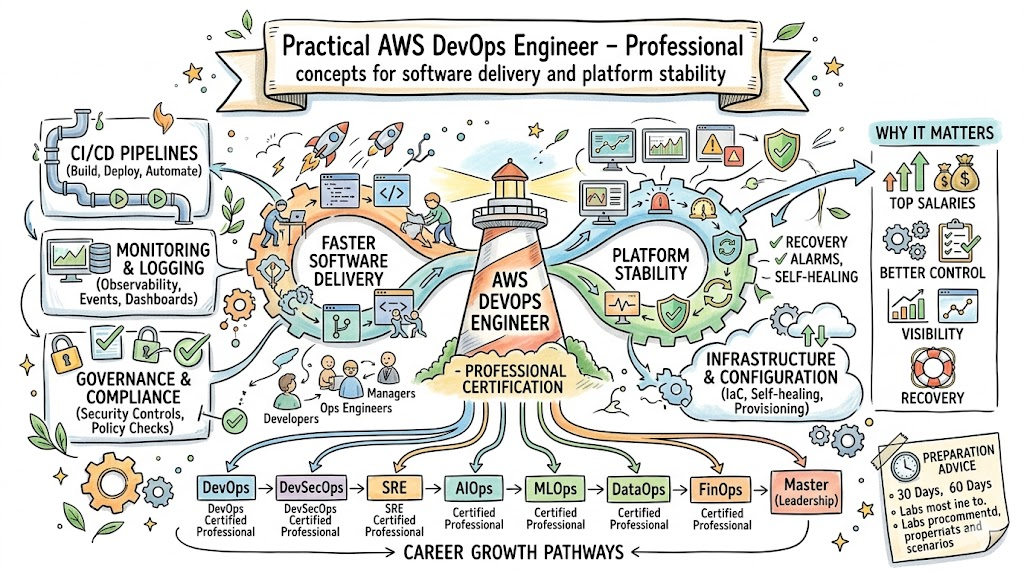
AWS DevOps Engineer – Professional becomes useful because it brings those pieces into one direction. AWS says this certification validates the ability to automate testing and deployment of AWS infrastructure and applications, while the DevOpsSchool certification page presents it as a program focused on operating and managing distributed systems on AWS with CI/CD, governance, observability, compliance, and high-availability practices.
For beginners, the biggest value is clarity. Instead of studying random tools without context, you start seeing how software is built, released, monitored, secured, and improved inside a real cloud workflow.
What it is AWS Certified DevOps Engineer – Professional
The AWS Certified DevOps Engineer – Professional is a high-level technical benchmark that confirms an individual’s capability to provision, operate, and manage distributed systems at an enterprise scale. It signifies a profound understanding of the entire software development lifecycle, specifically focusing on the automation of security controls, compliance standards, and dynamic configuration management. By achieving this status, an engineer proves they can move beyond basic scripting to engineer robust, fault-tolerant environments that utilize advanced AWS services to minimize manual intervention and maximize system reliability across complex global infrastructures.
Why it Matters in Today’s Software, Cloud, and Automation Ecosystem
Today, companies do not only want people who can create cloud resources. They want engineers who can help teams release software faster, reduce deployment mistakes, improve alerting, and keep systems stable in production. AWS directly connects this certification to automation, security controls, governance, and operational practices that matter in modern cloud delivery.
This matters in both India and global markets. AWS highlights strong salary value for the certification, and UK job market data shows AWS DevOps roles with a recent median salary of £77,500, with London and remote roles reaching £100,000 median in the same dataset.
India-focused DevOps roadmaps also continue to place AWS, automation, CI/CD, and cloud operations near the center of job-ready skill building.
A beginner may not become a senior DevOps engineer overnight, but this certification helps define the path. It shows what practical cloud teams expect from people working around deployment, reliability, automation, and operations.
Why choose DevOpsSchool
DevOpsSchool distinguishes itself as a premier training partner by bridging the gap between theoretical cloud concepts and high-stakes production environments. They offer a practitioner-led curriculum that prioritizes project-based learning, ensuring that engineers don’t just memorize AWS services but master the muscle memory required for real-world automation, CI/CD orchestration, and incident response. With a strong focus on the Indian and global job markets, their programs are specifically designed to help professionals navigate the rigor of the Professional-level exam while gaining the practical skills needed to lead digital transformation initiatives in enterprise settings.
What You Learn When You Follow This Path
What is this certification
Think of AWS DevOps Engineer – Professional as a bridge between software delivery and cloud operations. It is meant for people who need to make application delivery smoother and production systems easier to manage on AWS.
This is why the certification feels different from a basic cloud course. It is not only about knowing services. It is about learning how those services work together during build, release, monitoring, governance, and incident handling.
Who this take this path
- Newer cloud engineers who already know some AWS basics and want a clearer next step.
- Software engineers who want to understand deployment and operations better.
- Junior DevOps learners who want a structured learning direction.
- Support engineers moving toward automation and cloud delivery.
- Team leads or managers who need a practical view of release flow and production readiness.
Skills you will gain
- Build CI/CD pipelines using AWS-native delivery services.
- Automate infrastructure provisioning and environment setup.
- Use monitoring, metrics, logging, and alarms for operational visibility.
- Apply governance controls, security checks, and compliance validation in delivery workflows.
- Improve uptime through high-availability thinking and self-healing approaches.
- Handle incidents better through event-driven operations and recovery planning.
Real-world projects you should be able to do after it
- A release pipeline for a simple application running on AWS.
- A safer deployment model using canary or blue/green rollout techniques.
- A monitoring setup with logs, metrics, and alerts for service health.
- A rules-based delivery process with approvals, tagging, and policy checks.
- A basic recovery design for failure situations in cloud environments.
- An automation routine for repetitive operational tasks.
Certification table
Choose your future lane
- DevOps: Best for learners who want stronger delivery pipelines and release automation.
- DevSecOps: Best for people who want to connect deployment speed with secure delivery.
- SRE: Best for learners interested in uptime, alert quality, and production reliability.
- AIOps/MLOps: Best for people exploring intelligent automation or ML systems in production.
- DataOps: Best for learners working with reliable data movement and data pipeline operations.
- FinOps: Best for people who want to understand cloud cost control with engineering decisions.
Role-wise certification map
| Role | Suggested certification path |
|---|---|
| DevOps Engineer | AWS DevOps Engineer – Professional → DevOps Certified Professional |
| SRE | AWS DevOps Engineer – Professional → SRE Certified Professional |
| Platform Engineer | AWS DevOps Engineer – Professional → Kubernetes CKA/CKAD → SRE Certified Professional |
| Cloud Engineer | AWS DevOps Engineer – Professional → DevOps Certified Professional |
| Security Engineer | AWS DevOps Engineer – Professional → DevSecOps Certified Professional |
| Data Engineer | AWS DevOps Engineer – Professional → DataOps-focused learning |
| FinOps Practitioner | AWS DevOps Engineer – Professional → FinOps-focused learning |
| Engineering Manager | AWS DevOps Engineer – Professional → leadership-oriented DevOps learning |
Best next certification after this one
- Same-track option: DevOps Certified Professional.
- Cross-track option: SRE Certified Professional or DevSecOps Certified Professional.
- Leadership option: A wider DevOps leadership or architecture learning path.
Preparation windows
- 7–14 days
This works only for learners who already use AWS, IAM, monitoring, deployment tools, and troubleshooting in daily work. It is a short revision path, not a beginner foundation plan.
- 30 days
This is a practical target for many working professionals. Divide time across automation, infrastructure setup, monitoring, governance, and resilience topics.
- 60 days
This is the better option for beginners or role changers. It gives enough space to build a small project, revise core AWS services, and understand how release flow works from start to finish.
Mistakes beginners often make
- Jumping into advanced tools before understanding the delivery lifecycle.
- Memorizing service names without doing hands-on practice.
- Ignoring logs, alerts, and operational visibility because pipelines seem more exciting.
- Skipping compliance and governance topics, even though they are part of real delivery work.
- Studying one service at a time instead of learning the full application journey.
A simple beginner plan
- Start with the flow — source code, build, test, deploy, monitor, improve.
- Create one small project — even a basic app pipeline is enough.
- Study AWS services with purpose — learn where each one fits.
- Practice failure scenarios — ask what happens when deployment or service health breaks.
- Revise using situations, not only definitions — this certification rewards applied judgment.
Institutions that support training and certification preparation
- DevOpsSchool fits learners who want live classes, projects, and practical support.
- Cotocus is often considered for cloud and DevOps upskilling.
- Scmgalaxy is known for technical training in automation and software delivery topics.
- BestDevOps is a common option for certification-linked learning.
- devsecopsschool.com helps learners moving toward secure delivery practices.
- sreschool.com supports reliability and production operations learning.
- aiopsschool.com is useful for intelligent automation and observability-led topics.
- dataopsschool.com supports data pipeline and data operations learning.
- finopsschool.com is relevant for cloud cost governance and optimization awareness.
Beginner FAQs
1) Can a fresher start with AWS DevOps Engineer – Professional?
A complete fresher may find it difficult because the certification expects prior AWS exposure, coding familiarity, automation experience, and operating system knowledge. DevOpsSchool also lists two or more years of experience managing AWS environments as part of the expected background.
2) I know basic AWS only. Is that enough?
Basic AWS is a helpful start, but you should also understand Linux, Git, scripting, IAM, CI/CD ideas, and simple deployment flow before taking this seriously.
3) Is coding compulsory?
You do not need to be a full-time developer, but familiarity with at least one high-level programming language is listed as a prerequisite.
4) Do I need real job experience before learning DevOps?
Real experience helps a lot, but beginners can still start by learning the workflow, building mini-projects, and understanding how delivery happens in AWS.
5) What should I learn before this certification?
Start with AWS basics, Linux commands, networking basics, Git, scripting, one CI/CD tool, and simple monitoring concepts.
6) Is this certification only about deployment?
No. It also covers monitoring, logging, governance, security controls, compliance validation, and high-availability operations.
7) Will labs help more than theory?
Yes. The DevOpsSchool course page itself highlights 100+ lab assignments and scenario-based projects, which shows how important practical learning is for this path.
8) How many months should a beginner keep for preparation?
A beginner usually benefits more from a 60-day path than a short sprint because it allows time to learn concepts and build small projects.
9) Is this good for a software engineer who wants to move into cloud roles?
Yes. It helps software engineers understand release pipelines, infrastructure automation, and production operations in AWS-based teams.
10) Is this useful in India?
Yes. India’s hiring landscape continues to value AWS, CI/CD, automation, and cloud operations skills in product firms, consulting organizations, and global capability centers.
11) Can this certification help with salary growth later?
Yes, the broader skill set is linked to valuable cloud roles, and AWS highlights strong salary value for the certification in industry reporting.
12) What is the easiest way to begin today?
Pick one small application, place it in version control, automate build and deployment, add logs and alarms, and learn the workflow step by step.
AWS DevOps Engineer – Professional: 8 focused FAQs
1. How does the difficulty of the Professional exam compare to Associate-level certifications?
The Professional exam is exponentially more challenging; while Associate exams focus on identifying service features, the Professional level requires you to troubleshoot complex, multi-tier failure scenarios and architect end-to-end automation under strict constraints.
2. Are there any mandatory prerequisites before I can attempt the DOP-C02 exam?
There are no formal prerequisites required by AWS to sit for the exam, but it is a standard industry recommendation to have at least two years of hands-on experience and a solid grasp of the Associate-level SysOps or Developer domains.
3. What is the typical passing score and the format of the examination?
The exam consists of 75 questions (multiple choice or multiple response) to be completed within 180 minutes, requiring a minimum passing score of 750 out of 1000 points.
4. Which technical domains carry the most weight in the certification syllabus?
The syllabus is divided into six domains, with SDLC Automation (22%) and Configuration Management/Infrastructure as Code (17%) being the most critical, followed closely by Security, Compliance, and Monitoring.
5. How much time should a working professional dedicate to preparation?
Most successful candidates dedicate between 80 to 120 hours of focused study over a period of 2 to 3 months, balancing theoretical documentation with intensive hands-on lab practice.
6. Does this certification significantly impact salary expectations in the global market?
Yes, this is consistently ranked as one of the highest-paying cloud certifications globally; in India, for example, it often facilitates a salary jump to the ₹25–45 LPA range for experienced engineers.
7. How long does the certification remain valid after passing the exam?
The certification is valid for three years, after which you must pass the most current version of the Professional exam to maintain your active status and demonstrate your knowledge of the latest AWS innovations.
8. Which specific AWS services must I master to pass this professional-level test?
You must have deep architectural knowledge of the AWS Developer Tools suite (CodePipeline, CodeBuild, CodeDeploy), alongside AWS CloudFormation, AWS Config, Systems Manager, CloudWatch, and AWS Lambda for cross-account automation.
Conclusion
AWS DevOps Engineer – Professional is useful for learners who want to move beyond basic cloud knowledge and understand how real AWS delivery systems work. AWS positions it around automation, deployment, governance, monitoring, and resilience, while DevOpsSchool supports that path through instructor-led sessions, labs, and projects.
The best way to use this certification is as a roadmap, not just an exam target. Learn the workflow, build a few small projects, and grow from service knowledge into real cloud delivery thinking.
