Introduction
Software development has changed dramatically over the past decade. Organizations are no longer managing a handful of monolithic applications hosted on a few servers. Today’s engineering teams build cloud-native applications, microservices, APIs, serverless functions, and AI-powered services that require consistent deployment, monitoring, security, and governance.
Managing this complexity through manual processes is no longer practical. High-performing organizations solve this challenge by building modern software delivery platforms—standardized environments that automate the journey from source code to production while providing developers with secure, repeatable, and self-service workflows.
This guide explains how organizations can design a modern software delivery platform using DevOps principles, Kubernetes, GitOps, Infrastructure as Code, DevSecOps, and Platform Engineering.
Why Traditional Software Delivery No Longer Works
Many organizations still rely on fragmented workflows:
- Manual server provisioning
- Different deployment methods across teams
- Inconsistent security controls
- Limited monitoring
- Environment drift
- Slow release approvals
These practices increase operational risk and reduce engineering productivity.
A unified software delivery platform addresses these issues by standardizing the entire application lifecycle.
What Is a Modern Software Delivery Platform?
A software delivery platform is an internal engineering ecosystem that combines tools, automation, governance, and best practices into a consistent developer experience.
Instead of every team creating its own deployment scripts and infrastructure, the platform provides reusable capabilities such as:
- Source code repositories
- Automated CI/CD pipelines
- Infrastructure templates
- Kubernetes deployment standards
- Secret management
- Observability dashboards
- Security policies
- Self-service environments
This allows developers to focus on building software rather than managing infrastructure.
Core Components of the Platform
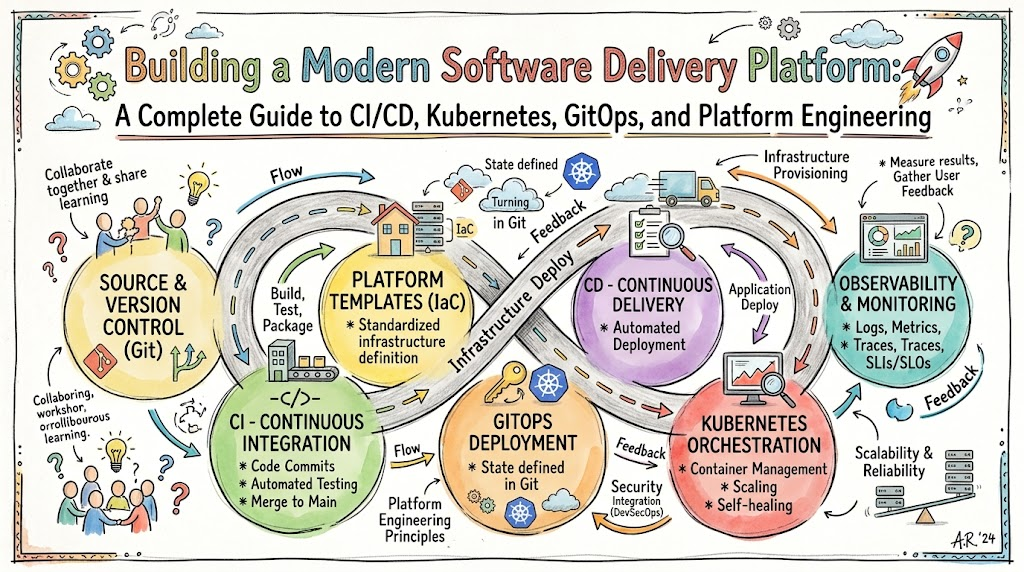
A complete platform typically includes the following layers:
Source Control
Everything begins with version-controlled repositories that store application code, infrastructure definitions, configuration files, and deployment manifests.
Continuous Integration
Automated builds validate every code change through compilation, testing, and quality checks before artifacts are published.
Continuous Delivery
Deployment pipelines promote applications through development, staging, and production environments using consistent automation.
Infrastructure as Code
Cloud infrastructure is provisioned using reusable templates, ensuring repeatable environments and simplified disaster recovery.
Kubernetes Orchestration
Containerized applications are deployed, scaled, and managed using Kubernetes, providing resilience and portability.
GitOps
Git becomes the source of truth for infrastructure and application configurations. Approved changes are automatically synchronized to target environments.
Observability
Metrics, logs, traces, and dashboards provide visibility into platform health and application performance.
Security
Security checks are integrated throughout the platform, including code scanning, dependency analysis, container validation, and policy enforcement.
Designing an Internal Developer Platform
An Internal Developer Platform (IDP) simplifies the developer experience by providing self-service capabilities.
Typical features include:
- Environment provisioning
- Deployment templates
- Service catalogs
- Documentation portals
- Secret management
- Monitoring dashboards
- Automated compliance checks
By reducing repetitive operational work, IDPs enable developers to deliver software more efficiently.
Creating Reusable CI/CD Templates
Instead of every team designing pipelines from scratch, organizations can build standardized templates that include:
- Source checkout
- Dependency installation
- Automated testing
- Code quality analysis
- Security scanning
- Artifact publishing
- Deployment automation
- Rollback procedures
Reusable templates improve consistency and reduce maintenance effort.
Standardizing Kubernetes Operations
A scalable Kubernetes strategy includes:
- Namespace conventions
- Resource quotas
- Role-based access control
- Network policies
- Backup strategies
- Cluster upgrades
- Autoscaling
- Logging and monitoring
Standardization simplifies platform management as engineering teams grow.
Embedding DevSecOps into the Platform
Security should be integrated into every workflow rather than treated as a separate stage.
Platform capabilities may include:
- Static application security testing
- Dependency vulnerability scanning
- Container image validation
- Infrastructure policy checks
- Secret detection
- Compliance reporting
Developers receive immediate feedback without slowing delivery.
Observability by Design
A platform should provide built-in observability rather than expecting individual teams to configure monitoring independently.
Essential capabilities include:
- Centralized logging
- Metrics collection
- Distributed tracing
- Service health dashboards
- Intelligent alerting
- Performance analytics
This improves incident response and operational visibility.
Measuring Platform Success
Key performance indicators include:
| Metric | Business Benefit |
|---|---|
| Deployment Frequency | Faster software delivery |
| Lead Time | Improved development efficiency |
| Platform Adoption | Standardization across teams |
| Change Failure Rate | Better release quality |
| Mean Time to Recovery | Improved operational resilience |
| Developer Satisfaction | Better engineering experience |
Regular measurement supports continuous improvement.
Common Implementation Challenges
Organizations often encounter:
- Legacy systems
- Cultural resistance
- Tool sprawl
- Skills shortages
- Governance complexity
- Security integration
- Cost management
A phased implementation strategy helps address these challenges while minimizing disruption.
The Role of Training and Consulting
Technology alone does not guarantee success.
Organizations benefit from experienced trainers and consultants who can:
- Assess existing environments
- Design platform architectures
- Deliver hands-on workshops
- Mentor engineering teams
- Establish governance standards
- Guide long-term adoption
Combining consulting with structured training accelerates platform maturity.
Future of Software Delivery Platforms
Emerging trends include:
- AI-assisted deployment analysis
- Intelligent automation
- Policy as Code
- Platform engineering at scale
- FinOps integration
- Self-healing infrastructure
- Enhanced developer portals
Organizations investing in these capabilities will be better prepared for future software delivery demands.
Decision Guide
This guide is valuable for:
- Platform Engineers
- DevOps Engineers
- Cloud Architects
- Engineering Managers
- Enterprise Architects
- CTOs
- Organizations building Internal Developer Platforms
- Companies adopting Kubernetes and GitOps
Frequently Asked Questions
1. What is a software delivery platform?
A software delivery platform provides standardized tools, automation, and governance that support the complete software development lifecycle.
2. How does Platform Engineering differ from traditional DevOps?
Platform Engineering focuses on building reusable internal platforms that improve developer productivity, while DevOps emphasizes collaboration and automation across software delivery.
3. Why is GitOps important?
GitOps improves deployment consistency by treating Git repositories as the authoritative source for infrastructure and application configurations.
4. What role does Kubernetes play?
Kubernetes provides orchestration for containerized applications, enabling scalable, resilient, and portable deployments.
5. Why should organizations standardize CI/CD pipelines?
Standardized pipelines reduce maintenance effort, improve consistency, and simplify compliance across engineering teams.
6. What are Internal Developer Platforms?
IDPs provide self-service capabilities that allow developers to provision environments, deploy applications, and access shared engineering services.
7. How is security integrated into the platform?
Security is embedded through automated code analysis, dependency scanning, container validation, policy enforcement, and compliance checks.
8. What metrics should platform teams track?
Deployment frequency, lead time, change failure rate, recovery time, platform adoption, and developer satisfaction are common indicators.
9. Who benefits from Platform Engineering?
Developers, operations teams, security engineers, platform engineers, and business stakeholders all benefit from standardized software delivery processes.
10. How can organizations begin building a software delivery platform?
Start with an assessment of current workflows, identify standardization opportunities, automate core processes, introduce governance, and invest in team training.
Conclusion
Modern software delivery platforms bring together automation, governance, Kubernetes, GitOps, Infrastructure as Code, observability, and security into a unified engineering experience. By standardizing these capabilities, organizations improve developer productivity, reduce operational complexity, and accelerate software delivery. Success depends not only on technology but also on continuous learning, collaboration, and a clear platform strategy that evolves with business needs.
