Introduction
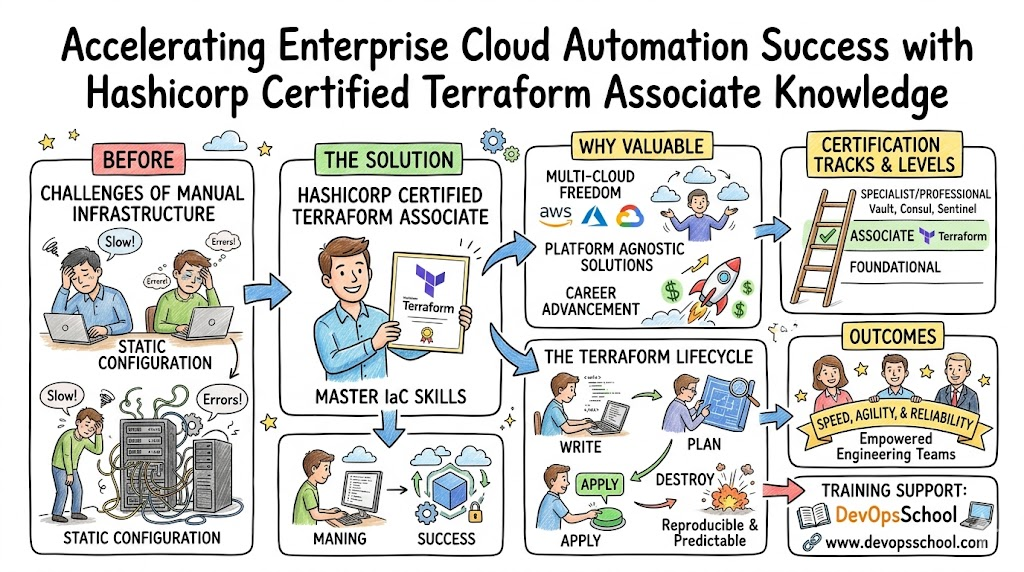
Engineers who master automation today secure the most influential roles in the global technology landscape. You recognize that manual server configuration slows down innovation and increases the risk of catastrophic outages. By pursuing the Hashicorp Certified Terraform Associate through DevOpsSchool, you transition from a traditional operator to a high-value platform architect. This guide serves as your technical compass to navigate the complexities of Infrastructure as Code (IaC) while making data-driven decisions for your career progression. I have designed this resource to help working professionals in India and across the world understand exactly how to leverage this credential for long-term success.
What is the Hashicorp Certified Terraform Associate?
The Hashicorp Certified Terraform Associate represents a professional milestone that validates your proficiency in infrastructure automation using the Hashicorp Configuration Language (HCL). It confirms that you understand the lifecycle of a resource, from initial initialization to final destruction. This program prioritizes hands-on competence over theoretical knowledge, ensuring you can manage production-grade environments with confidence. You learn how to interact with diverse cloud APIs through a single, unified syntax that standardizes operations across your entire organization.
Modern engineering teams rely on Terraform to provide a “single source of truth” for their cloud assets. This certification exists to verify that you can handle the critical mechanics of state management, dependency resolution, and resource isolation. It aligns with enterprise needs by focusing on stability, repeatability, and transparency in infrastructure deployments. By earning this credential, you prove that you can move beyond the limitations of cloud-specific tools and adopt a truly multi-cloud operational strategy.
Who Should Pursue Hashicorp Certified Terraform Associate?
Cloud engineers, systems administrators, and site reliability engineers (SREs) derive the most immediate value from this certification path. If you currently spend hours in a web console clicking through menus, you need this credential to automate those tasks and regain your time. Security professionals also benefit significantly, as they can use Terraform to audit infrastructure configurations before the first server even launches. Data engineers find it useful for provisioning large-scale clusters without relying on a separate operations team for every change.
In the competitive Indian market and the global tech arena, this certification acts as a powerful differentiator for software engineers moving into DevOps roles. Engineering managers often pursue this track to gain a deeper understanding of the automation frameworks their teams utilize daily. It helps leaders make better architectural decisions and sets a high bar for technical excellence within the department. Even beginners with basic cloud knowledge can use this Associate level to build a strong foundation in the principles of software-defined infrastructure.
Why Hashicorp Certified Terraform Associate is Valuable
Terraform has become the industry standard for infrastructure orchestration, making this certification a highly durable asset for your resume. Companies across the globe are migrating to multi-cloud architectures, and they desperately need engineers who can manage these complex environments without learning five different proprietary languages. This credential demonstrates your commitment to tool-agnostic automation, ensuring your skills remain relevant regardless of which cloud provider your company chooses. You gain a massive return on investment as your ability to deliver infrastructure increases exponentially compared to manual methods.
Earning this certification empowers you to take ownership of the entire delivery pipeline, reducing the “toil” that often leads to burnout in technical roles. Organizations value Terraform experts because they minimize human error and eliminate the “snowflake” server problem where every environment differs slightly. You become a catalyst for faster release cycles, directly impacting the business’s ability to respond to market changes. Ultimately, this credential provides you with the technical authority to lead large-scale digital transformation projects that define modern enterprise success.
Hashicorp Certified Terraform Associate Certification Overview
The program delivers its curriculum via the Hashicorp Certified Terraform Associate training and holds its official presence on the DevOpsSchool website. This certification uses a performance-based assessment approach that evaluates your grasp of the core CLI commands, provider logic, and state file security. It focuses on the practical application of Terraform in team settings, including how to handle concurrency and version control. You must demonstrate that you can safely modify existing infrastructure without causing downtime for the end-users.
Hashicorp owns and manages the certification standards, ensuring that the exam reflects the latest features and best practices of the tool. The exam structure usually includes multiple-choice questions, matching tasks, and scenario-based problems that reflect daily engineering challenges. It pushes you to understand the “behind-the-scenes” mechanics of how Terraform interacts with cloud providers to maintain the desired state. By passing this exam, you signal to employers that you possess the technical maturity to manage their most critical digital assets using industry-standard automation.
Hashicorp Certified Terraform Associate Certification Tracks & Levels
The Terraform certification hierarchy guides you through a logical progression from basic resource management to advanced governance. At the foundational level, you learn the philosophy of Infrastructure as Code and the basic structure of a configuration file. The Associate level serves as the core validation for most working engineers, focusing on the day-to-day tasks of provisioning and managing cloud resources. It ensures you have a firm grasp of the “Terraform workflow” that includes initialization, planning, and application phases.
Advanced tracks and professional levels dive into the complexities of the Hashicorp ecosystem, including secret management and service discovery. These specializations allow you to tailor your learning to your specific career path, whether you focus on security (DevSecOps) or massive-scale reliability (SRE). As you move up the levels, you transition from individual resource management to designing entire automated platforms that serve thousands of developers. This structured progression helps you build a deep, versatile skill set that supports long-term career growth in the platform engineering domain.
Complete Hashicorp Certified Terraform Associate Certification Table
| Track | Level | Who it’s for | Prerequisites | Skills Covered | Recommended Order |
| Infrastructure Automation | Foundational | Aspiring Cloud Admins | Basic Linux Knowledge | IaC Theory, HCL Syntax | 1st |
| Cloud Operations | Associate | DevOps/SRE Engineers | 6 Months Hands-on | CLI, State, Modules | 2nd |
| Governance & Security | Professional | Security Architects | Associate Certificate | Sentinel, Vault, RBAC | 3rd |
| Service Orchestration | Specialty | Platform Architects | Associate Certificate | Consul, Service Mesh | 4th |
Detailed Guide for Each Hashicorp Certified Terraform Associate Certification
Hashicorp Certified Terraform Associate – Associate Level
What it is
This certification proves you can use the Terraform CLI to build, change, and version cloud infrastructure safely. It validates your technical understanding of the Hashicorp Configuration Language and the internal mechanics of the Terraform state engine.
Who should take it
Engineers with roughly half a year of experience using Terraform in real-world scenarios should pursue this credential. It is perfect for those who want to transition from a generic “Cloud Admin” role to a specialized “DevOps Engineer” or “SRE” position.
Skills you’ll gain
- Mastery of the Terraform core workflow including init, plan, apply, and destroy commands.
- Ability to manage complex state files and implement remote backends with state locking.
- Expertise in building reusable modules to standardize infrastructure across different teams.
- Understanding of how to utilize dynamic blocks and built-in functions for flexible configurations.
- Proficiency in managing diverse cloud providers through a single configuration interface.
Real-world projects you should be able to do
- Deploy a highly available, multi-tier web application across multiple availability zones.
- Build a centralized networking hub using VPC peering or Transit Gateway modules.
- Implement a secure remote state management system using encrypted storage and DB locking.
- Create a standardized “Environment-as-a-Service” template for development and testing teams.
Preparation plan
- 7–14 days: Focus on the official Hashicorp tutorials and the core CLI commands. Practice writing simple resource blocks for a provider like AWS or Azure.
- 30 days: Build a comprehensive project using modules and remote state. Practice troubleshooting state drift and importing existing resources into your configuration.
- 60 days: Dive deep into Terraform Cloud features and advanced HCL functions. Take multiple practice exams to get comfortable with the scenario-based question format.
Common mistakes
- Storing the state file in a local directory instead of a secure, shared remote backend.
- Failing to use version constraints for providers and modules, leading to unexpected breakages.
- Hardcoding sensitive secrets or environment-specific values directly into the main configuration files.
- Running the “Apply” command without carefully reviewing the output of the “Plan” stage first.
Best next certification after this
- Same-track option: Hashicorp Vault Associate for infrastructure security and secret management.
- Cross-track option: Certified Kubernetes Administrator (CKA) for container orchestration.
- Leadership option: AWS Certified Solutions Architect – Professional for high-level system design.
Choose Your Learning Path
DevOps Path
Engineers on the DevOps path use Terraform to break down the barriers between software development and IT operations. You focus on integrating infrastructure provisioning directly into the CI/CD pipeline, ensuring that the environment is ready the moment the code is built. This path emphasizes speed, automation, and the use of “Infrastructure as Code” to create perfectly identical environments for testing and production.
DevSecOps Path
The DevSecOps path integrates security into the very heart of the infrastructure provisioning process. You learn how to use Terraform to enforce encryption, manage access controls, and run automated security scans on your configurations before they launch. This path ensures that security is never a bottleneck but rather a built-in feature of the automated delivery system.
SRE Path
Site Reliability Engineers (SREs) prioritize the uptime, performance, and scalability of the production environment. You use Terraform to manage “Infrastructure as Code” as a way to reduce manual toil and eliminate the human errors that cause outages. This path focuses on state management, disaster recovery, and the creation of self-healing systems that can survive region-wide cloud failures.
AIOps Path
AIOps professionals leverage Terraform to provision the massive, dynamic infrastructure required for artificial intelligence operations. You focus on creating flexible environments that can scale up or down based on the computational needs of your intelligence models. This path requires a deep understanding of how to manage high-performance compute and specialized storage resources through code.
MLOps Path
The MLOps path centers on the specialized infrastructure needs of the machine learning lifecycle. You use Terraform to ensure that the data science team has consistent environments for training models and deploying them into production. This path bridges the gap between data science and platform engineering, ensuring that models transition smoothly from research to real-world use.
DataOps Path
DataOps practitioners use Terraform to build and manage the complex pipelines that move data across the enterprise. You focus on automating the provisioning of data warehouses, streaming services, and analytics platforms with the same rigor used in software development. This path ensures that your data infrastructure is reliable, secure, and ready to handle massive volumes of information.
FinOps Path
The FinOps path involves using Terraform to gain visibility and control over cloud spending. You learn how to tag resources, set up cost estimation in your pipelines, and automate the destruction of unused assets to save money. This path ensures that your technical automation decisions align with the company’s financial goals and budget constraints.
Role → Recommended Hashicorp Certified Terraform Associate Certifications
| Role | Recommended Certifications |
| DevOps Engineer | Terraform Associate, Jenkins Engineer, CKA |
| SRE | Terraform Associate, Prometheus Specialist, CKA |
| Platform Engineer | Terraform Associate, Consul Associate, Vault Associate |
| Cloud Engineer | Terraform Associate, AWS/Azure Solutions Architect |
| Security Engineer | Terraform Associate, Vault Associate, Cloud Security |
| Data Engineer | Terraform Associate, Databricks/Snowflake Cert |
| FinOps Practitioner | Terraform Associate, FinOps Certified Practitioner |
| Engineering Manager | Terraform Associate, ITIL Foundation |
Next Certifications to Take After Hashicorp Certified Terraform Associate
Same Track Progression
Once you master Terraform, you should expand your expertise within the Hashicorp stack to build a complete “Cloud Operating Model.” Pursuing the Hashicorp Vault Associate certification allows you to manage the secrets and identities that your Terraform code uses. Following that with the Consul Associate certification helps you manage service networking and connectivity across diverse environments. Together, these certifications prove you can build, secure, and connect modern cloud-native applications from the ground up.
Cross-Track Expansion
Broadening your skills into container orchestration and cloud-specific architecture makes you a much more versatile engineer. I highly recommend the Certified Kubernetes Administrator (CKA) because Terraform and Kubernetes are the “dynamic duo” of modern platform engineering. You could also pursue a professional-level certification from a major provider like AWS or Microsoft Azure. This combination of tool-specific and cloud-specific knowledge ensures you can solve complex architectural problems that span multiple layers of the technology stack.
Leadership & Management Track
If you aim for leadership roles, you must shift your focus toward strategy, governance, and team performance. The FinOps Certified Practitioner is an excellent choice for showing that you understand the financial impact of technical decisions. You might also consider the ITIL Foundation or a specialized program in Technical Product Management to bridge the gap between engineering and business. These certifications prepare you to lead large-scale digital transformations and manage technical departments that deliver high-value results to the organization.
Training & Certification Support Providers for Hashicorp Certified Terraform Associate
- DevOpsSchool
DevOpsSchool provides a robust learning platform designed specifically for working professionals who need to master infrastructure automation. Their Terraform curriculum focuses on real-world scenarios, moving beyond the basics to teach you how to handle complex state management and multi-cloud providers. They offer live, instructor-led sessions that provide immediate feedback and help you troubleshoot difficult concepts in a lab environment. By choosing this provider, you gain access to a wealth of industry experience that prepares you for both the certification exam and the daily challenges of a DevOps role. - Cotocus
Cotocus stands out as a premium provider of technical training and consulting for cloud-native technologies. Their Terraform Associate program is built on the principle of “learning by doing,” offering students dozens of hands-on exercises that mimic production environments. They specialize in high-impact workshops that help engineering teams quickly adopt new tools and improve their operational efficiency. The instructors bring a wealth of consulting experience, ensuring that the training you receive is grounded in current industry trends and best practices. - Scmgalaxy
Scmgalaxy is a massive knowledge repository and community hub that has supported software configuration professionals for over a decade. They offer an extensive library of free and premium resources, including practice exams, video tutorials, and technical blogs dedicated to the Terraform ecosystem. Their community-driven approach allows you to connect with thousands of other engineers to share solutions and stay updated on the latest tool releases. For self-directed learners who value a strong support network, this platform is an essential part of the certification journey. - BestDevOps
BestDevOps delivers focused, high-quality training that strips away the fluff and focuses on the skills you actually need for the job. Their Terraform course is meticulously designed to help you pass the Associate exam while building a solid foundation in Infrastructure as Code. They offer personalized support and a structured learning path that ensures you stay on track and meet your certification goals. This provider is an excellent choice for engineers who want a clear, results-oriented training program that fits into a busy work schedule. - devsecopsschool.com
devsecopsschool.com prioritizes the intersection of security and automation, making it a top choice for professionals in the DevSecOps domain. Their Terraform training includes specialized modules on “Policy as Code” and secret management, teaching you how to build security into every layer of your infrastructure. They prepare you to handle the strict compliance requirements of modern enterprises by automating security checks and audits. Graduates from this program are uniquely qualified to lead security-focused automation projects in high-stakes industries like finance and healthcare. - sreschool.com
sreschool.com caters specifically to Site Reliability Engineers who use Terraform to maintain system stability and performance. Their curriculum focuses on the operational aspects of Infrastructure as Code, including disaster recovery, state file migration, and drift detection. They teach you how to build self-healing infrastructure that can survive significant cloud outages without manual intervention. For engineers who are passionate about reliability and operational excellence, this provider offers the most relevant and deep technical training available in the market. - aiopsschool.com
aiopsschool.com leads the way in training engineers for the future of AI-driven infrastructure management. Their Terraform course explains how to automate the massive compute clusters and specialized data storage required for artificial intelligence at scale. They show you how to use automation to handle the unique volatility and scaling demands of intelligence-driven applications. This is a visionary choice for engineers who want to stay at the cutting edge of technology and lead the next wave of infrastructure innovation. - dataopsschool.com
dataopsschool.com addresses the specific needs of data engineers and architects who are responsible for the enterprise data platform. Their Terraform training shows you how to bring the discipline of DevOps to the world of big data by automating the setup of data lakes and streaming pipelines. They emphasize the importance of repeatability and security in data environments, ensuring your infrastructure is as reliable as your code. This provider is the perfect partner for professionals who want to master the automation of their data-heavy technical stack. - finopsschool.com
finopsschool.com focuses on the critical intersection of cloud automation and financial management. Their Terraform curriculum teaches you how to use code to gain visibility into cloud spending and implement automated cost-saving measures. You learn how to justify your technical decisions with hard financial data and how to build “frugal” infrastructure that doesn’t sacrifice performance. For those looking to excel in the growing field of FinOps, this provider offers the most comprehensive and practical training for mastering cloud economics through automation.
Frequently Asked Questions
- How much hands-on experience do I need before taking the exam?
Candidates usually find the most success after working with Terraform for at least six months in a real-world or lab-intensive environment.
- Is the Terraform Associate exam held online or in person?
The exam is available as a proctored online session, allowing you to take it from your home or office anywhere in the world.
- What is the typical passing score for the Hashicorp certification?
Hashicorp does not publish an exact passing percentage, but most candidates aim for a score of 70% or higher to ensure success.
- Do I need to be an expert in HCL syntax to pass the exam?
You should have a strong grasp of the basic structure, including how to define resources, variables, outputs, and modules effectively.
- Does this certification help with getting a job in India?
Yes, Indian tech companies and global MNCs heavily value this certification when hiring for DevOps, SRE, and Cloud Architect positions.
- How long does the Hashicorp Certified Terraform Associate remain valid?
The certification stays active for two years, after which you must retake the exam to keep your skills current with tool updates.
- What is the format of the questions on the exam?
You will encounter multiple-choice questions, multiple-selection tasks, and some text-matching or “drag-and-drop” scenario problems.
- Is Terraform Cloud covered in the Associate level exam?
Yes, you should understand the basic features of Terraform Cloud, including its purpose, workspace management, and how it differs from the CLI.
- Can I use a Mac or Windows machine to learn Terraform?
Terraform is platform-agnostic, meaning you can practice and work with it on Linux, macOS, or Windows without any major differences.
- Is there a prerequisite certification before I take the Associate level?
There are no formal prerequisites, but having a basic understanding of cloud computing concepts is extremely helpful for context.
- How much does the certification exam cost?
The exam fee is generally around 70.50 USD, though you should check the official Hashicorp site for the most current pricing.
- What happens if I fail the exam on my first attempt?
Hashicorp allows you to retake the exam, but you must pay the full fee again and wait for a specified cooling-off period between tries.
FAQs on Hashicorp Certified Terraform Associate
- Practitioners often ask: what makes the Terraform state file so critical?
The state file is the only way Terraform knows which real-world resources correspond to your code; without it, you lose the ability to update or destroy assets safely.
- Does Terraform support multi-cloud deployments in a single configuration?
Yes, you can define multiple providers (like AWS and Azure) within the same project, allowing you to build complex architectures that span across different cloud platforms.
- What is the purpose of the “Terraform Plan” command?
The plan command generates a dry-run output that shows you exactly what changes Terraform will make, acting as a crucial safety check before any real resources are altered.
- How do modules improve the quality of infrastructure code?
Modules allow you to wrap complex resource configurations into a single, reusable component, which reduces code duplication and ensures consistency across your entire organization.
- Can Terraform manage non-cloud resources like GitHub or Datadog?
Yes, Terraform uses providers to communicate with any service that has an API, including SaaS tools, monitoring platforms, and even on-premises hardware.
- What is “Infrastructure as Code” in simple terms?
It is the practice of managing your servers, networks, and databases through machine-readable files instead of manual configuration or clicking through web consoles.
- How does Terraform handle sensitive information like passwords?
You should use sensitive variables or integrate Terraform with secret management tools like Hashicorp Vault to prevent passwords from appearing in plain text.
- Why is the “Terraform Init” command necessary?
The init command prepares your working directory by downloading the necessary provider plugins and setting up the backend where your state file will live.
Final Thoughts: Is Hashicorp Certified Terraform Associate Worth It?
Building a career in modern cloud operations requires more than just knowing how to use a cloud provider; it requires the ability to automate at scale. Deciding to earn the Hashicorp Certified Terraform Associate is a strategic move that places you at the forefront of the platform engineering revolution. It proves to employers that you possess the technical discipline to treat infrastructure with the same rigor as software code, which is a rare and highly sought-after trait. Whether you are working in a major Indian tech hub or for a global startup, this credential provides the professional authority you need to lead your team toward a more automated and reliable future. Practical experience remains the best teacher, but this certification forces you to explore the corners of the tool that you might never encounter in a single project. It broadens your architectural perspective and gives you the confidence to manage thousands of resources without fear of manual errors. In an industry that values speed and stability above all else, mastering Terraform is not just an option—it is a requirement for long-term success. If you are ready to stop being a “firefighter” and start being an “architect,” this certification is the best place to begin your transformation.
